




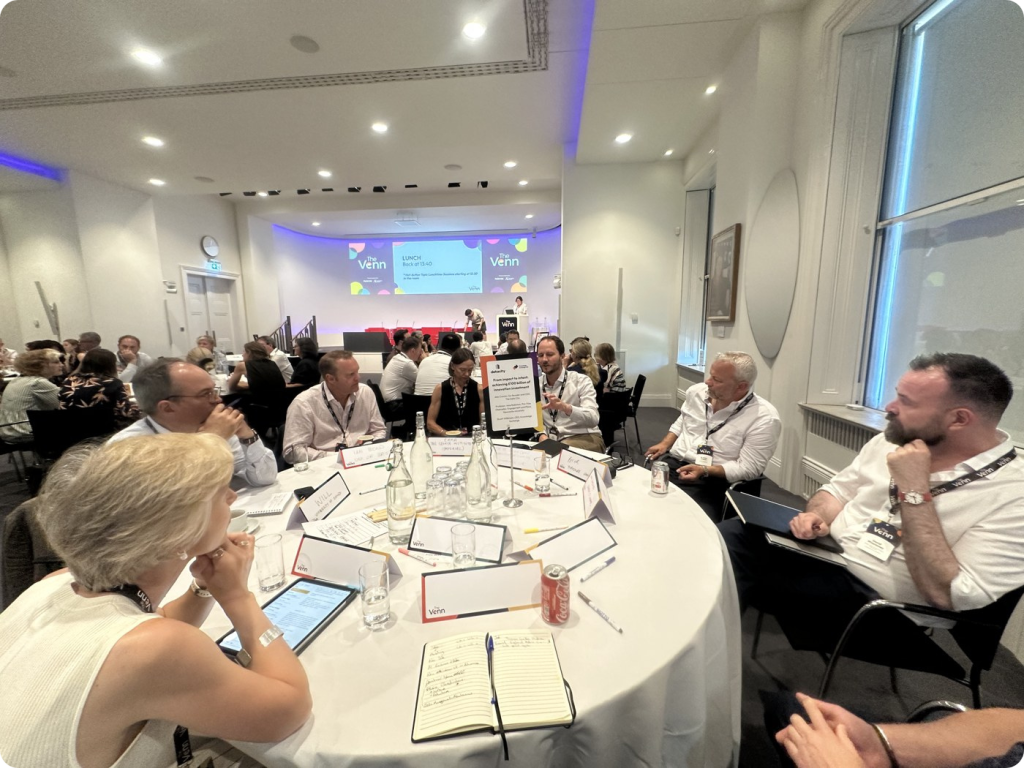
This week we hosted a roundtable at The Venn, as part of the Hot-button Topic lunchtime sessions run with Knowledge Exchange UK and their Advisory Circle. The session, titled ‘From impact to intent: achieving £100 billion of innovation investment’, brought together knowledge exchange leaders, pro-vice-chancellors, founders and people from across government around a single, deliberately awkward question.
It was a working conversation rather than a panel, and we want to keep this write-up in the same spirit: an honest account of where the discussion got to, and where we think it could go next.
There was a particular reason for us to be hosting it. We were on this stage at The Venn last year, when all we had was the idea: that a university ought to be able to see, in one place, where its research connects to the real economy. Some of the people who came up afterwards agreed to help us build it. So this year’s session was, in part, us reporting back. Here is what we built, working with Favier Ltd and Metro Dynamics, and here is the conversation it is designed to serve. That felt like the right way round: start with the sector’s question, not our product.
The shift the sector is making
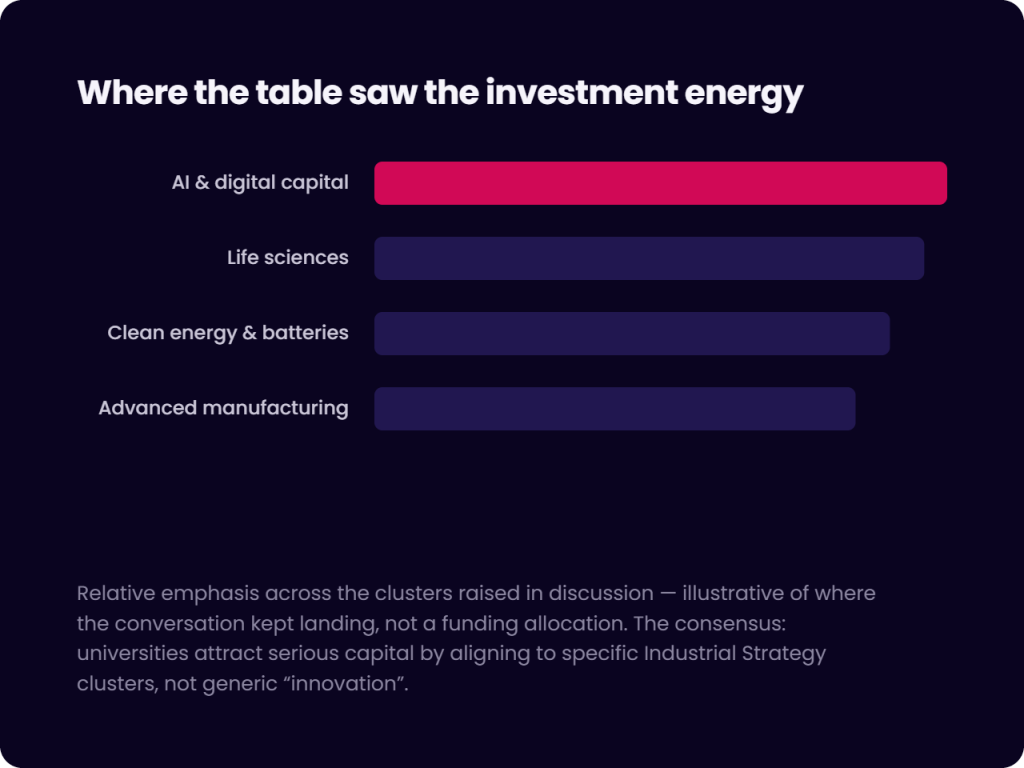
The backdrop is Universities UK’s new ambition to help double external investment into UK University innovation, from around £5 billion a year today to £10 billion, which compounds to more than £100 billion flowing into spinouts, startups and social enterprises over the decade to 2035. Universities do not receive this money. They have to attract it, by convening investors, founders, mayors and government, and by proving where their research connects to real companies and growth sectors.
That is the move several people in the room kept returning to: from evidencing impact (what a university has already done) to demonstrating intent (where it is going, where its strengths lie, and why an investor should back them). As one contributor put it, the UK is good at idea formation and good at starting companies; the difficulty is scaling them, holding onto the IP, and keeping the businesses here.
Why it can no longer sit with one team
A recurring theme was that this work is too big, and too cross-cutting, to live in a single office. It touches commercialisation, research and knowledge exchange, regional partnerships, alumni and global campus networks all at once. Several voices argued that knowledge exchange professionals are well placed to lead the response, but only if they can see the whole picture rather than the fraction any one team happens to hold.
That came through most sharply in the part of the conversation about mapping. There was real appetite for being able to see innovation spaces, the companies inside them, and the connections between university and private-sector clusters, alongside a candid acknowledgement that, today, most institutions can only see a slice of their own network. You cannot pitch a pipeline to a mayor, or align to an Industrial Strategy sector with confidence, if you cannot first see where your strengths already connect to real, growing businesses.
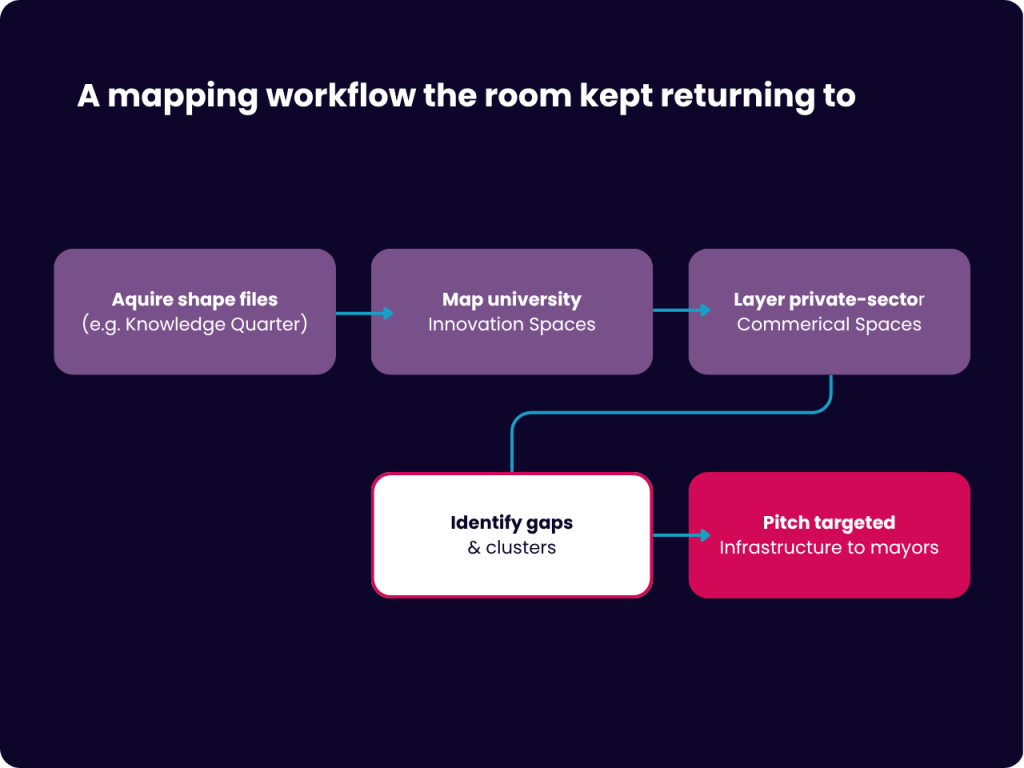
The connections already exist. What matters is whether a university can see them, evidence them, and act on them before someone else does.
Where we think the discussion goes next
We won’t pretend to have the answer, and we don’t think anyone in the room would claim to either. But a few things felt like firmer ground by the end.
If the sector is shifting from impact to intent, then the evidence base has to shift with it. Demonstrating intent means showing, company by company and sector by sector, where a university’s research, spinouts, funded partnerships and alumni already touch the growth economy, and where the gaps are that investment could fill. That is a data problem as much as a strategy one, and it is the kind of problem we like working on at The Data City.
It is also why we have been building the University Industry Impact Explorer with a small group of alpha partners. The Explorer maps the live connections between UK universities and UK companies: research collaborations, Innovate UK and KTP partnerships, spinouts, and alumni director and founder networks. It aggregates them across the eight Industrial Strategy growth sectors, so a university can see its full network, benchmark against peers, and surface the companies it should be engaging but isn’t yet. We would not call it the answer to a £100 billion ambition. It is one useful input to a conversation the sector is only just beginning.
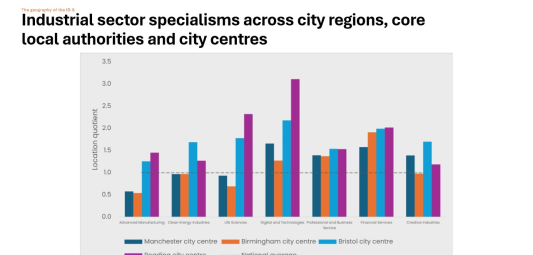
If that sounds ambitious, it is worth saying the underlying approach already operates at national scale. We helped the Department for Science, Innovation and Technology build the first iteration of their Innovation Clusters Map, which shows where the country’s innovation actually happens, by sector and by place, using live firm-level data rather than SIC codes. It still runs on our real-time classifications today. The University Industry Impact Explorer applies the same engine at the level of a single institution: the same live company data, focused on one university’s connections to the businesses around it.
What we took away from The Venn is a strong desire to keep that conversation going, with knowledge exchange leaders, with UUK, with mayors and with founders, and to support whatever the sector decides with the best data and insight we can bring. The targets will be set by others. Our role is to make the connections visible enough that the case for investment can be made with confidence.
Continue the conversation
If your institution is wrestling with how to evidence intent, and where your research connects to high-growth companies, we’d value your perspective. The University Industry Impact Explorer is in alpha with a small number of partners, and we’re keen to learn from more.
Thanks to Knowledge Exchange UK and the Advisory Circle for convening the session, and to everyone around the table at The Venn. Investment figures and the £100bn ambition as reported by Universities UK, 24 June 2026.