




We’re retiring our original Life Sciences Real Time Industrial Classification and replacing it with a new Life Sciences Tools and Services RTIC. Understandably, that raises a question for anyone who has been using the old RTIC to track the sector: can you still map life sciences on the Industry Engine? You can. In fact, the two routes in this post are the best way to do it, and they work whatever definition of life sciences your analysis needs.
Standard Industrial Classification (SIC) codes can no longer map today’s Life Sciences sector. A cell therapy manufacturer, a contract research organisation, and an AI drug discovery platform can all end up filed under the same broad pharmaceutical SIC code, because those codes were last meaningfully updated before engineering biology, modern CDMOs, or AI-driven drug discovery existed as distinct sectors.
The Industry Engine takes a different approach. Real-Time Industrial Classifications (RTICs) classify companies based on what they actually do, using real-time analysis of website content, rather than a code they declared at Companies House years ago.
Start with your definition
What does “Life Sciences” mean for your work?
If you need a consistent, recognised definition for policy analysis, economic research, investment, or benchmarking against national frameworks, use the ready-made Life Sciences Industrial Strategy Classification (Route 1).
If your definition is your own (broader, narrower, or simply different), build a custom list from RTICs and verticals (Route 2).
Here’s how each route works.
Route 1: Use the ready-made core definition
The simplest place to start is the Industrial Strategy Classifications panel on our dashboard. Developed with The Productivity Institute, government, and industry, these classifications use real-time company data to map the UK’s eight Industrial Strategy sectors, and Life Sciences is one of them.
Pre-Build Definition
Step one: Open the Industry Engine, go to Dashboard, and scroll to Industrial Strategy Classifications to select Life Sciences.
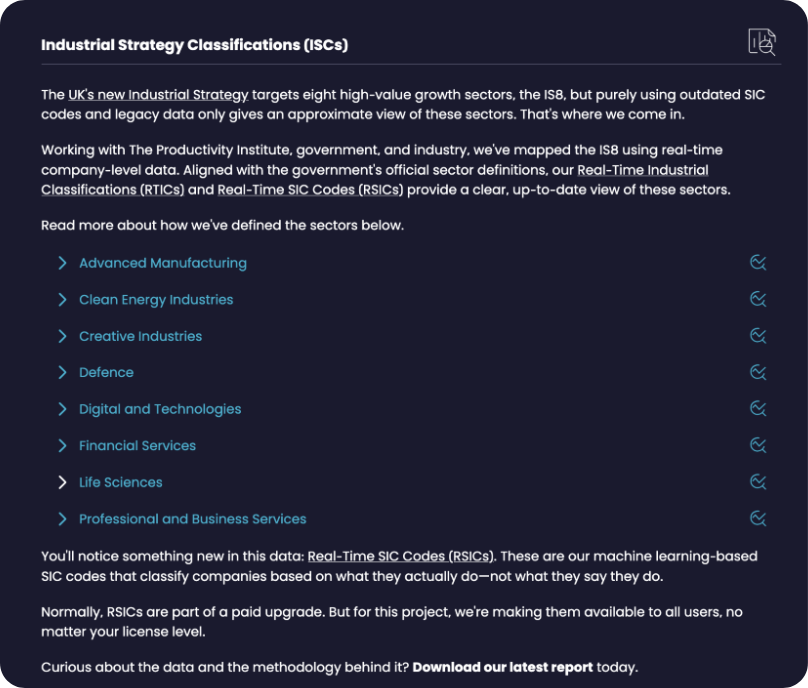
Step two: Click on Life Sciences and look through the many sectors and subsectors mapped. Use our filters (location, turnover and more) and analysis function to tell your life science story with our data.
What this definition covers
The Life Sciences Industrial Strategy Classification offers an overview of the UK’s entire Life Sciences sector by combining RTICs and Real-Time SIC codes (RSICs). It consolidates six RTICs (Omics, Medtech, Pharma, Life Sciences Tools and Services, Biopharmaceuticals, and Neurotechnology) alongside RSIC codes such as manufacture of basic pharmaceutical products, manufacture of pharmaceutical preparations, production of irradiation and electromedical equipment, medical and dental instruments and supplies, and research and development in biotechnology. Together these give you a view of the core Life Sciences sector.
When to choose this route
This is particularly useful for policy analysis, economic research and any context where a consistent, ready-made definition matters. It was built with The Productivity Institute and government, so using it puts your analysis in line with national frameworks.
Route 2: Build your own definition with RTICs and verticals
If the core definition doesn’t fit, you can build your own. We have RTICs covering everything from Medtech to Neurotechnology, each subdivided into more specific verticals. You can combine any RTICs and verticals you choose. Want AI-driven drug discovery? Add it. Need equipment manufacturers in Life Sciences too? Add them also.
How to build the list
Step one: Log in to the Industry Engine and go to Explore.
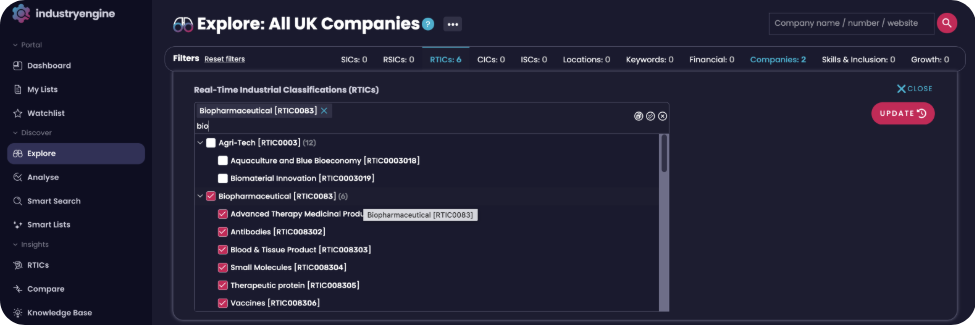
Step two: Click on the RTICs tab and select RTICs and verticals from different RTICs to build a list of companies to your exact specification.
Here’s an example. First, we select some RTICs to include and establish the initial list as a starting point:
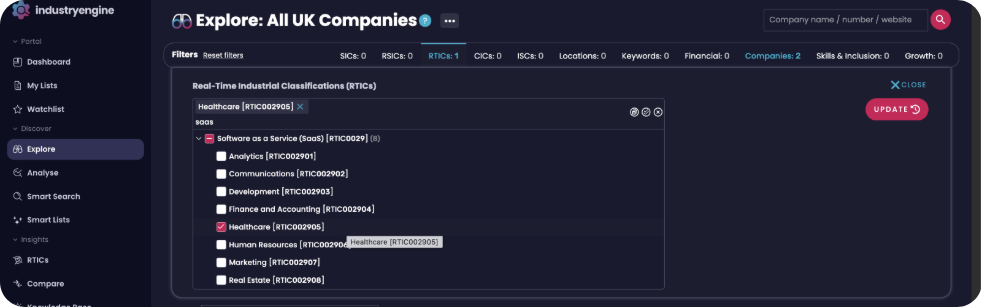
Then we add relevant verticals within different RTICs, continuing until every RTIC and vertical that defines your concept of Life Sciences is included:
Once complete, you’ll be able to see the breakdown into sub-sectors and use our analysis function along with various filters to gain insights into your definition of Life Sciences.
When to choose this route
Choose this route whenever your work calls for something more specific than the core definition: a niche within Life Sciences, an extended view that pulls in adjacent sectors, or a bespoke scope for a client or research question.
Which route fits your list?
The two tools answer different questions. Industrial Strategy Classifications give you a consistent, agreed-upon definition for benchmarking and policy. The RTIC approach lets you define Life Sciences your own way. However you choose to map it, the Industry Engine gives you the data to do it properly.
If you’re not sure which approach fits your use case, get in touch, we’re happy to help work through it.
Interested in exploring the data but not yet a customer? Sign up for a free trial.