




From mycelium steaks to bioacoustic biodiversity monitoring, the UK’s Agri-Tech sector is rethinking how we grow food, protect crops and feed a growing population. It is one of the fastest-moving parts of the economy, and it is full of small companies scaling at speed.
Agri-tech also sits at the centre of the government’s growth plans. It is named as one of six industries of the future in the Advanced Manufacturing Sector Plan, and advanced manufacturing is one of the eight growth-driving sectors in the UK’s Modern Industrial Strategy.
Using our AI-powered Real-Time Industrial Classifications (RTICs) for Agri-Tech, we have found the UK’s fastest-growing micro and small companies in the sector. RTICs are our answer to inaccurate SIC codes and out-of-date industry data.
Powered by AI, RTICs give precise insight into sectors like Agri-Tech and other emerging industries, putting real-time industry data at your fingertips.
These ten companies are growing fast, from fungal protein to crop microbiomes.
Agri-Tech shortlist summary
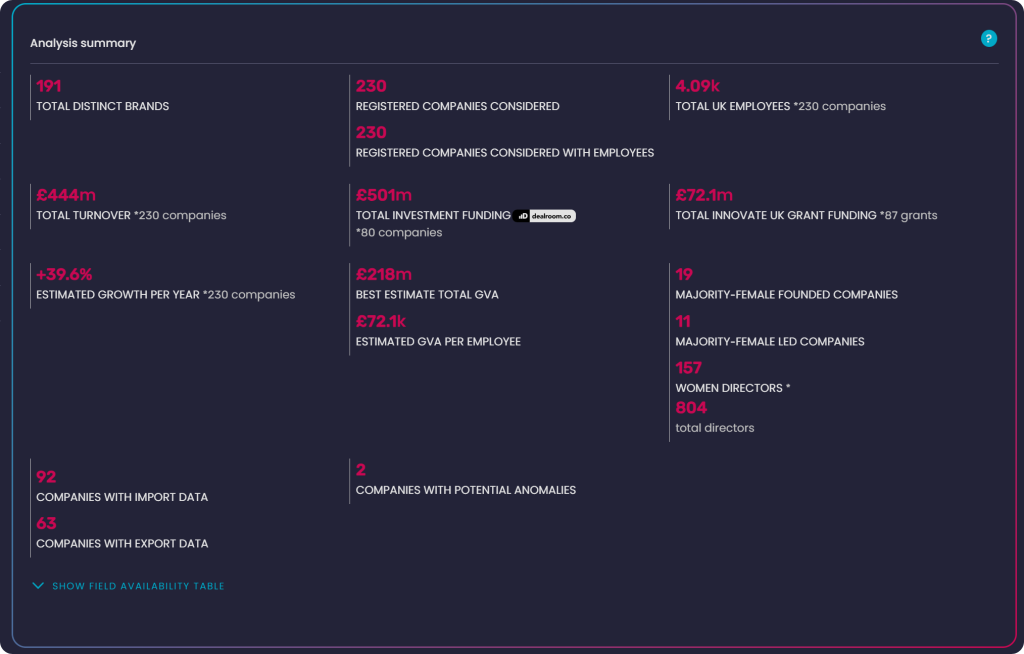
Before the top ten, here is a snapshot of the wider group these companies came from. After filtering, we considered 230 registered companies, spanning 191 distinct brands and employing 4,090 people across the UK.
Together they turn over £444m and generate an estimated £218m in gross value added (GVA), which works out at £72,100 per employee. They have raised £501m in private investment across 80 companies (via Dealroom) and pulled in £72.1m of Innovate UK grant funding across 87 grants. As a group, they are growing at an estimated +39.6% per year.
On diversity, 19 of these companies are majority-female founded and 11 are majority-female led, while women hold 157 of the 804 director seats, around one in five.
The following ten companies are sorted by highest best estimate growth per year. Growth is our best estimate based on the financial and company data behind each business, so treat it as a strong signal rather than an audited figure.
1. Chirrup
- Best estimate growth per year: +182.8%
- Estimated employee count: 8 (micro)
- Location: Chichester
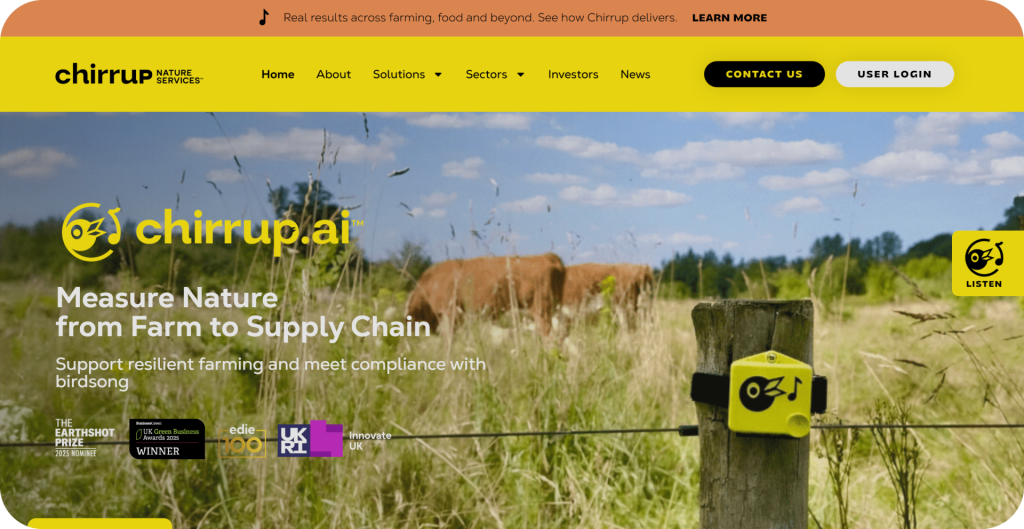
Chirrup turns the sounds of the natural world into biodiversity data. Land managers and businesses use Chirrup.ai to measure what is living on their land and show progress against sustainability goals, all from audio rather than expensive field surveys. A micro company of eight, incorporated in 2022, and the fastest grower on this list.
Their SIC code is ‘74909: Other professional, scientific and technical activities n.e.c.’, a catch-all that tells you nothing about what they do. Our RTICs place them in Agri-Tech under Soil and Habitat Health.
2. Adamo Foods
- Best estimate growth per year: +164.6%
- Estimated employee count: 18 (small)
- Location: Nottingham
Adamo Foods makes whole-cut steak from fungi. Its patented fermentation process grows mycelium into long, dense fibres that behave like the grain of a beef steak, using five natural ingredients and a fraction of the emissions. In 2026 the company secured a €10m EU Horizon Europe grant to scale production toward commercial volumes.
Their SIC code is ‘10890: Manufacture of other food products n.e.c.’. In our data they sit across Agri-Tech (Innovative Protein Sources and Sustainable Feed Solutions), FoodTech and Net Zero.

3. BugBiome
- Best estimate growth per year: +123.6%
- Estimated employee count: 5 (micro)
- Location: Norwich
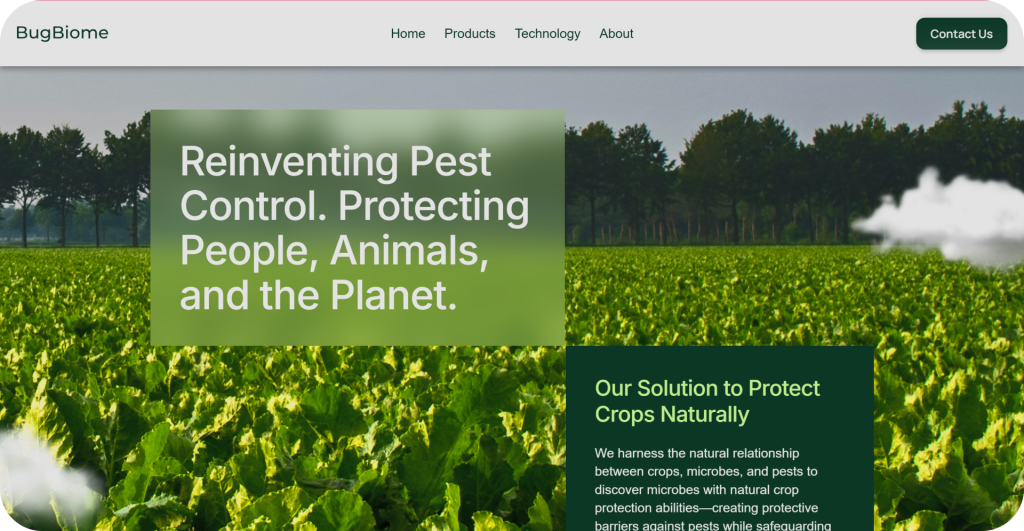
BugBiome is building safer pest control by tapping natural microbiomes. Its high-throughput screening platform hunts for microbes that can protect crops without the downsides of conventional chemical pesticides. A five-person micro company working out of the Norwich research cluster.
Our RTICs place BugBiome across four sectors: Agri-Tech, FoodTech, Life Sciences and Engineering Biology, with Agri-Tech subsectors covering soil, crop and input optimisation.
4. Radiant Matter
- Best estimate growth per year: +123.6%
- Estimated employee count: 11 (micro)
- Location: London
Radiant Matter makes colour without dyes or pigments. Its plant-derived materials produce structural colour, the same physics that gives a butterfly wing its shimmer, as a cleaner alternative for fashion and design.
Their SIC code is ‘74100: Specialised design activities’. We classify them under Agri-Tech, in Biomaterial Innovation.

5. ProtonDx
- Best estimate growth per year: +114.1%
- Estimated employee count: 36 (small)
- Location: London
ProtonDx is an Imperial College spinout building rapid, portable molecular testing. Its diagnostics and nucleic acid extraction products began in human health and extend into livestock, which is how the company lands in Agri-Tech alongside Life Sciences.
Their SIC code is ‘32500: Manufacture of medical and dental instruments and supplies’. Our RTICs surface their Agri-Tech work under Livestock Protection Technologies.

6. 30 Technology
- Best estimate growth per year: +112.1%
- Estimated employee count: 18 (small)
- Location: London
30 Technology develops nitric oxide-generating technology to fight antimicrobial-resistant infections. Its platform spans respiratory medicine, rare diseases and animal health, and that animal health work is what places it in our Agri-Tech RTIC under Livestock Protection Technologies. The company sold its wound-care assets to Convatec in a deal worth up to £176m.
Worth a flag for context: this is a biopharma business that reaches Agri-Tech through animal health rather than farming itself.
7. Arborea
- Best estimate growth per year: +99.4%
- Estimated employee count: 42 (small)
- Location: London
Arborea grows protein and functional food ingredients using photosynthesis. Its BioSolar Leaf technology aims at net-zero nutrition produced at scale. Incorporated in 2015, Arborea is the longest-established company on this list and still growing fast.
We classify Arborea across Agri-Tech (Innovative Protein Sources and Aquaculture and Blue Bioeconomy), Net Zero and Engineering Biology.

8. Nature Friendly Farming Network
- Best estimate growth per year: +96.6%
- Estimated employee count: 35 (small)
- Location: St Neots
The Nature Friendly Farming Network is a farmer-led membership organisation championing sustainable, nature-friendly farming across the UK. It connects farmers, shares practical knowledge, and campaigns for policy that supports soil, habitat and climate. The organisation is structured as a company limited by guarantee.
Their SIC codes ‘01610’ and ‘01629’ cover support activities for crop and animal production. We place them in Agri-Tech under Soil and Habitat Health.
9. Unibio International
- Best estimate growth per year: +94.9%
- Estimated employee count: 134 (classed small on turnover)
- Location: London
Unibio turns natural gas into protein. Its gas fermentation process produces a single-cell protein for animal feed, cutting the land and water that conventional feed crops demand. With 134 people, Unibio has the largest team on this list, and it qualifies as small on turnover and growth rather than headcount.
Their SIC code is ‘10910: Manufacture of prepared feeds for farm animals’. We classify them across Agri-Tech (Innovative Protein Sources and Sustainable Feed Solutions), Net Zero and Engineering Biology.
10. Concert Bio
- Best estimate growth per year: +91.5%
- Estimated employee count: 21 (small)
- Location: London
Concert Bio improves greenhouse crop performance through the plant microbiome. It uses data science to identify beneficial microbes and supply them to hydroponic growers, building the right microbiome for each crop to thrive.
Their SIC code is ‘72110: Research and experimental development on biotechnology’. In our data they span four Agri-Tech subsectors, from digital agriculture and geospatial data to controlled and circular agronomy systems.
How we built this list
We started with every company in our Agri-Tech RTIC, then applied a few filters to focus on home-grown, high-growth businesses:
- Only companies with a matched website
- UK companies only, excluding foreign businesses
- Excluding any company known to be ultimately foreign owned
- Micro and small companies only
We then sorted what was left by best estimate growth per year and took the top ten.
Why it matters
These are some of the fastest-growing small and micro companies in UK Agri-Tech, working on the problems that matter most: feeding more people, using less land, and cutting the environmental cost of food. Most employ fewer than 50 people. All of them are scaling fast.
The timing matters too. In June 2026, DEFRA announced a further £53 million for the Farming Innovation Programme, taking total investment to £123 million for 2026/27. Delivered with Innovate UK, it forms part of the Industrial Strategy’s commitment to invest at least £200 million in agricultural innovation by 2030. With agri-tech named as a priority in the Advanced Manufacturing Sector Plan, the companies on this list are growing into a sector the government has chosen to back.
At The Data City, we surface insights like this in seconds using our RTIC for Agri-Tech, which brings together company websites, financials, funding and more in one searchable platform.
Want to explore Agri-Tech in real time?
Sign up for a free trial and see the data for yourself.
Please note: data from The Data City is accurate at the time the article was written but may change over time due to the dynamic, real-time nature of our data. For the latest insights, visit our platform.