




Recently, we’ve been working hard to not just give you a legal view of the number of companies in the UK, but an economic view of the number of companies too.
In this blog, we want to introduce you to a new feature that helps us work towards that goal: Linked Companies.
Why we need Linked Companies
The Data City’s Industry Engine uses legally registered companies at its core. This provides us and our customers great flexibility to cut the data in different ways.
Legally registered companies do not always reflect the real world, however. A single brand can be made up of tens, hundreds, or sometimes thousands of subsidiary companies.
Our improvements to how we present group structure data have made this easier to understand. The largest group (by number of companies) in the UK is Specsavers, which is comprised of 1615 legal entities, all sat under Specsavers Optical Superstores Limited. We now report Specsavers as one “distinct brand”, rather than 1615 separate companies.
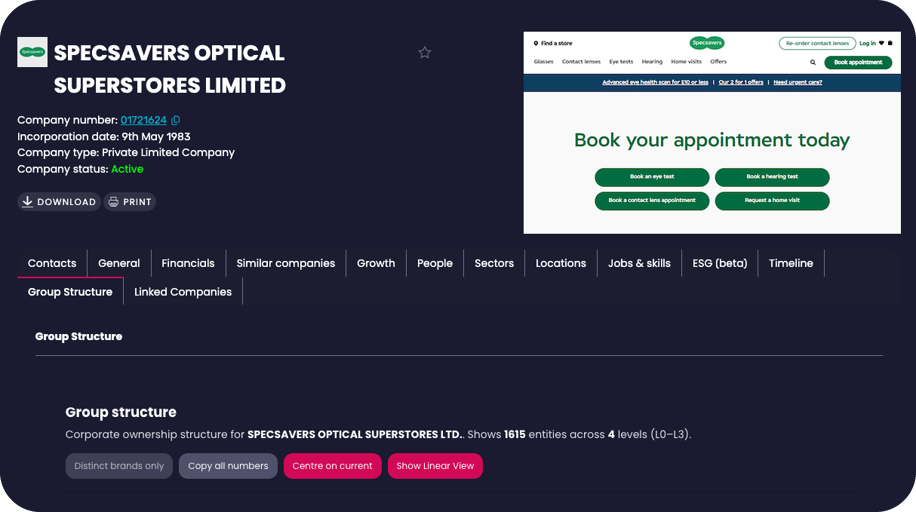
In doing this work, we noticed that our Group Structure data does not capture all the groups that we think exist. By eye, we could see that certain companies are linked in some way; usually it is because they have similar features like company names, websites, and registered addresses.
We therefore came up with the concept of Linked Companies to go even further in understanding the real number of businesses in the UK.
Linked Companies helps fill the gaps
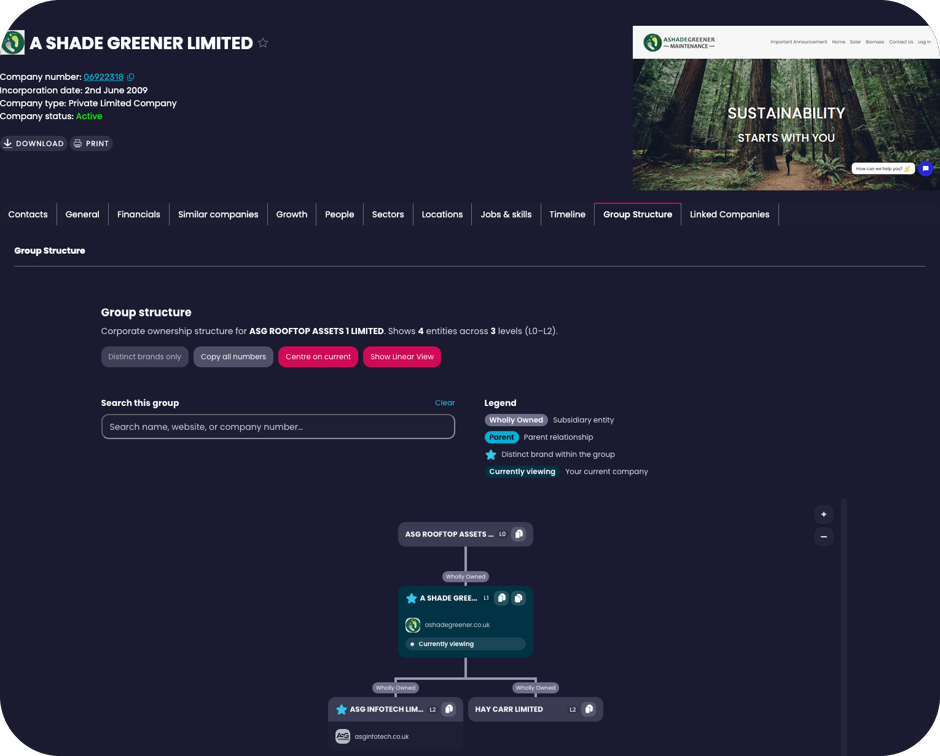
Using A Shade Greener Limited as an example, we can see that the company is part of a four-company group structure.
In contrast, our new Linked Companies tab shows that we think there are around 60 companies linked to A Shade Greener Limited.
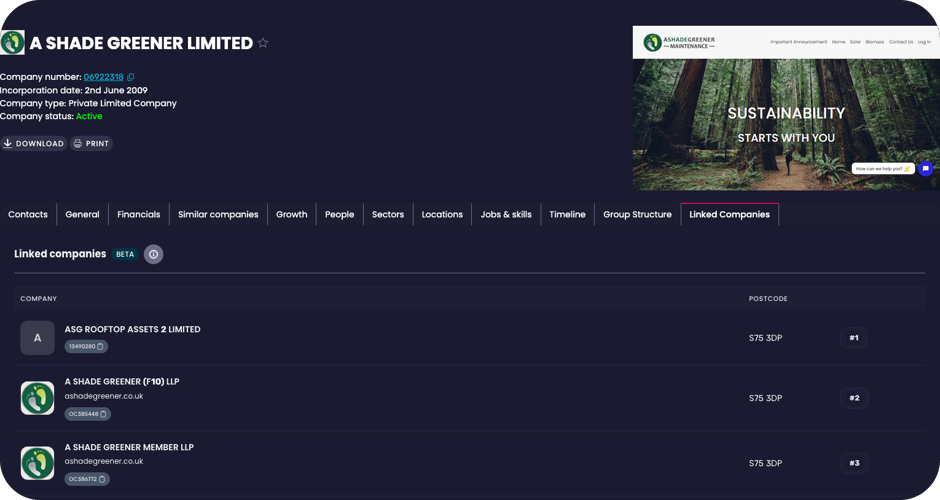
A Shade Greener Member LLP is registered at the same address, STERLING HOUSE MAPLE COURT, MAPLE ROAD, S75 3DP, and has the same person of significant control Mr Stewart James Davies.
We think these companies are likely to be part of the same organisation, even though our group structure data does not show this link.
How we identify Linked Companies
We use machine learning to estimate the probability that any two companies are linked. We consider companies to be linked if this probability exceeds 97%.
The data behind this model includes company names, registered addresses, matched websites, director information and more.
We train our model by providing it pairs of companies that are extremely likely to be linked.
Linked Companies data in the Industry Engine
You can see a company’s linked companies by clicking on the “Linked Companies” tab on a company page.
We currently have around 460k “clusters” or “groups” of linked companies, which contain approximately 1.5 million companies in total.
The first release of this data is under “beta” status, so we are still improving it.
Using Linked Companies in Analyse
Linked Companies identifies relationships between multiple registered companies that likely represent the same economic entity.
This data now contributes to Distinct Brands: where a group of Linked Companies exists, only the earliest incorporated company counts as a Distinct Brand.
This makes Distinct Brands a more accurate measure of the true number of independent companies in your analysis.

As of Industry Engine V6.2, we report 3.6 million distinct brands.
In total, we have been able to combine nearly a million companies by using improved website matching, group structure data, and now Linked Companies data too.
We’re working on improving Linked Companies to make Distinct Brands as accurate as possible. We think the final piece of the puzzle is to filter out Special Purpose Vehicles (SPVs) and Personal Consultancy Services (PCSs, small companies with one or fewer employees set up for side hustles or tax purposes), which will appear in industry Engine soon.
All these steps give a clearer, more accurate view of the economy, and you can start using it today.
Interested in getting hands on with our data? You can sign up for a free trial, or contact us if you have any questions.