




Our Real-Time SIC Codes (RSICs) have had their biggest upgrade since we launched them. All RSICs have been refreshed across the Industry Engine, in our API, and in Instant Classification.
This update focused on supporting RSICs to draw on more of what a company’s website says, providing more and richer evidence of what the company does. As a result, the new RSICs are sharper and more specific than ever, and meaningfully more accurate.
The best way to explain that is the same way we explained RSICs in the first place. Let us show you.
What are RSICs?
Real-Time SIC Codes (RSICs) are The Data City’s AI-powered fix for long-standing problems with traditional SIC codes: they’re often wrong, vague, or missing altogether. Instead of replacing the SIC code system, RSICs work within it, using AI to correct inaccurate codes, fill in gaps where none exist, and swap out catch-all classifications like “other” for something that actually describes what a company does.
This matters because over a million UK companies carry vague or incorrect SIC codes today, which creates real problems for anyone relying on that data for compliance, risk assessment, or investment decisions. RSICs clean this up, cutting out the manual checking that used to be the only way to get reliable classification data.
Is it actually better, or just different?
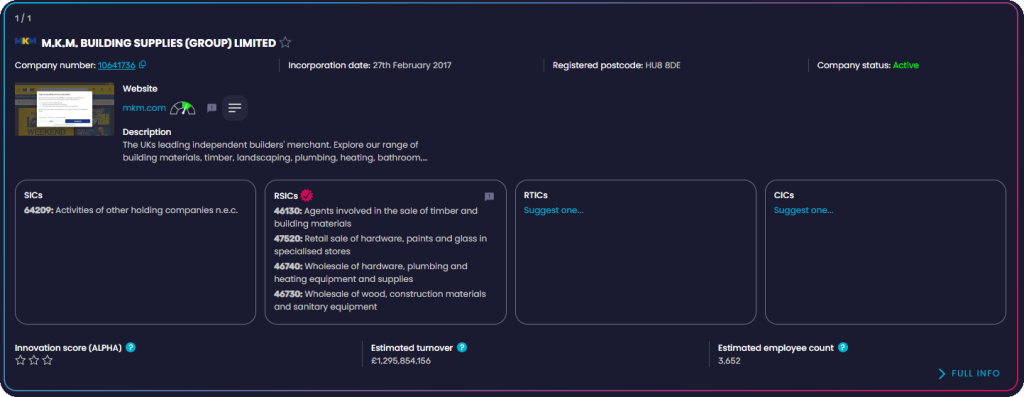
MKM (M.K.M Building Supplies (Group) Limited) is a builders’ merchant. It sells timber, plumbing, heating and landscaping supplies to the building trade. Because its website is full of the language about building, our old RSICs read it as a builder: development of building projects, construction of domestic buildings, joinery installation.
It is an easy mistake to make, and an instructive one. The new RSICs put MKM where it belongs: wholesale and retail of building materials, hardware, plumbing and heating. The right code had been in the old list all along but hidden amongst the construction codes.
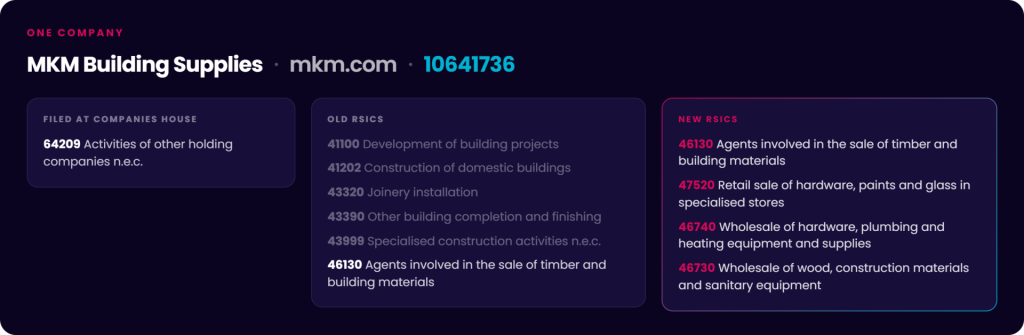
RSICs work by comparison. We do not read a website and decide; we work out which companies a business resembles, and then which codes that resemblance implies. A merchant that supplies the building trade reads a great deal like the builders it supplies. With richer evidence, and more of it, the comparison now separates the two.
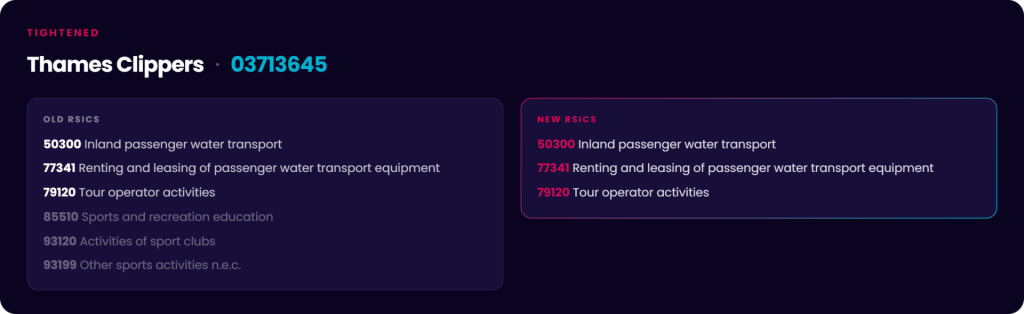
It is not just new for old. Thames Clippers (Collins River Enterprises Limited) runs the river bus service on the Thames, and its own registered SIC code says exactly that: Inland passenger water transport. We agreed with it before and we agree with it now, but three additional codes which had crept in from the edges of the site are gone, leaving three that all describe the business. Much more useful and meaningful.
Better in, better out
The model was always capable, we’ve just given it even more and even richer evidence to work with. Almost everything we have changed happens before the classification step.
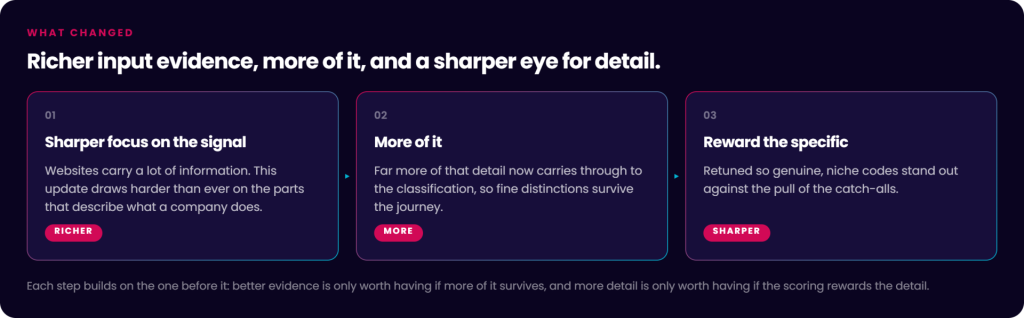
- Sharper focus on the signal. A company website carries a great deal of information, and only some of it describes the industry the business is in and its activity. This update draws harder than ever on the parts that genuinely describe what a company does, so the evidence behind every classification is even stronger.
- More of it. Far more of that detail now carries through to the classification. This matters because the distinctions our customers care about are fine ones. A commercial builder against a residential one, a specialist manufacturer against a general engineering firm. These differentiations matter, and they live in the detail.
- Reward the specific. We have retuned how codes are chosen so that specific, niche and genuinely descriptive codes stand out even more strongly against the pull of the catch-alls. A catch-all code is rarely wrong, it is simply far less meaningful, and therefore far less useful to anyone sizing a market or building a supplier list. Where we can identify a more informative alternative, we will. And now we can more often than ever before.
What’s the impact?
Most companies have seen an update, in one way or another. 82.6% of companies have seen a shift in their RSIC codes. The vast majority keep most of their old codes and swap one or two, as in the examples above, typically for something tighter or more meaningful. A smaller number have changed entirely. If you’re working with RSICs in your own systems, expect some movement across most of your records.
It’s live in Instant Classification too
The new RSICs are not just in the Industry Engine. They are also available in our Instant Classification, our focused tool for classifying a single company on demand. Enter a website, a UK company number or a short description of what a business does, and you get its RTICs, its RSICs, a list of 100 similar companies and a live description, in seconds.
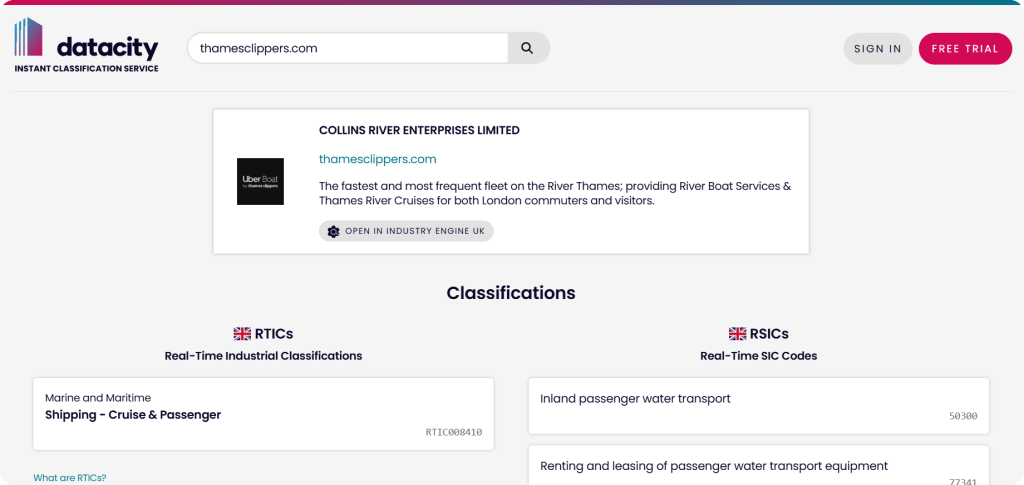
That matters most for the workflows Instant was built for. If you are onboarding a customer, running a credit or risk review, or issuing a policy, the classification you get at that moment is the one your decision rests on. Everything above arrives in those workflows automatically.
See it for yourself
The new RSICs are live now in the Industry Engine, in Instant Classification and via our API, so take a look. Or if you’re not yet working with us, book a demo to see what we can tell you about the companies you care about.