





Just how relevant are the Industrial Strategy’s priority sectors in your part of the country? It’s a question our platform can answer in detail, and we recently did it for Northern Ireland. Here are the headlines:
Northern Ireland has a number of Industrial Strategy sectoral strengths
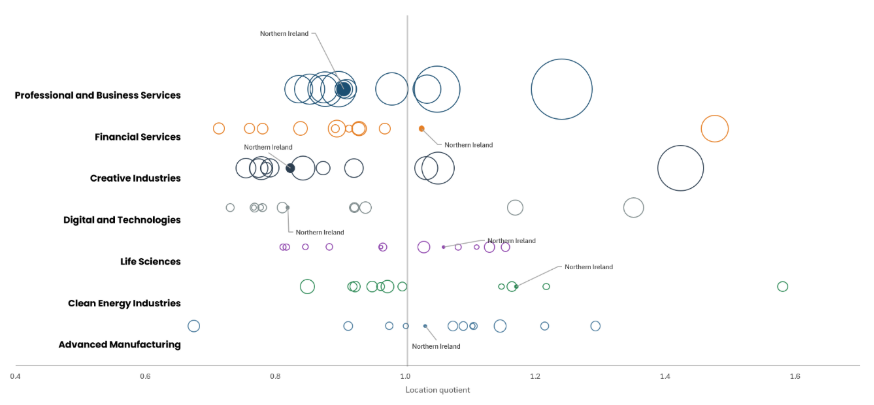
Northern Ireland has a concentration of activity across most Industrial Strategy priority sectors. Figure 1 plots this using location quotients – a score above 1 (to the right of the vertical line) means a region has a greater concentration of that industry than the national average. Bubble size shows the number of businesses in each sector.
Note: Size of the bubble represents the number of businesses
The chart shows that Northern Ireland does well across a number of sectors, having a relative specialism in Life Sciences, Clean Energy Industries (the third highest in the UK), Advanced Manufacturing and Finance.
These strengths are clustered in the Belfast area
These specialisms result mainly from activity within the Belfast Region City Deal (BRCD) area, which includes Belfast and its surrounding local authorities. Figure 2 compares specialisation profiles for the BRCD area, Other Northern Ireland, and the Northern Ireland total across all seven sectors. The BRCD area (red) records greater specialisms than the Northern Ireland average (green) for every sector. The rest of Northern Ireland (yellow), in turn, sits below the UK average across the board.
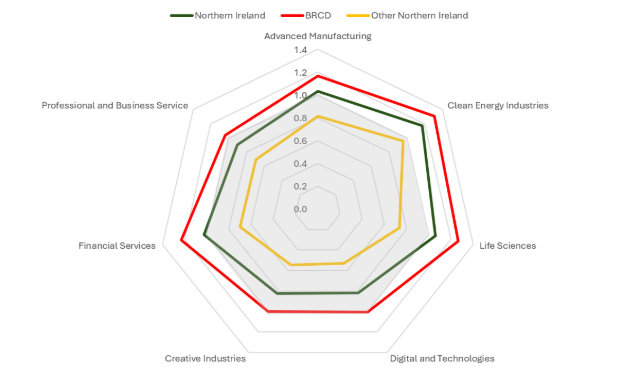
This picture isn’t especially surprising. Urban areas like Belfast offer a range of locational benefits that appeal to higher-skilled businesses in particular (a process known as ‘agglomeration’). The data shows the economic geography of Northern Ireland reflecting what we see both elsewhere in the UK and in other developed economies. This is important context for any strategy aiming to boost the nation’s economy.
Less urban parts perform better for ‘non-service’ sectors
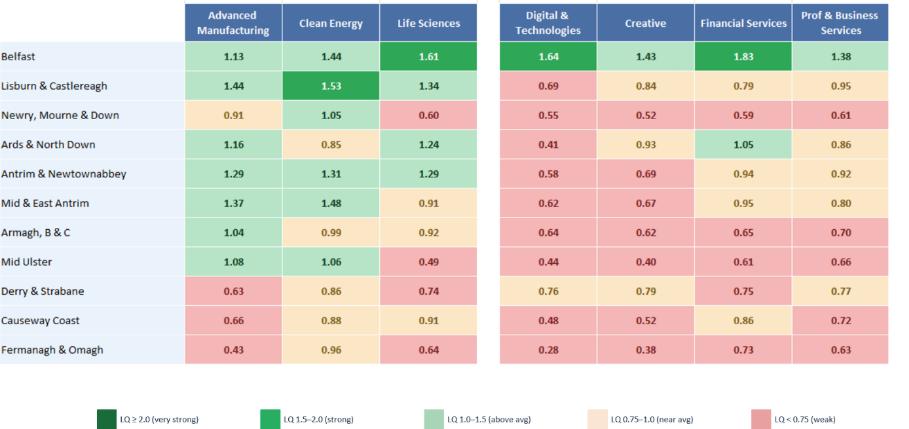
How well other parts of Northern Ireland do depends on the sector. Figure 3 shows the specialism of every local authority area against each Industrial Strategy sector, split into two groups: services-oriented sectors (Digital and Technologies, Creative, Financial Services, Professional and Business Services) and less services-oriented sectors (Life Sciences, Advanced Manufacturing, Clean Energy Industries).
There are three things that emerge:
- Belfast local authority has specialisms across all of the sectors.
- It is also the only local authority to perform well across all four services sectors (the right-hand side of Figure 3). Almost no other local authority has a services specialism: Northern Ireland’s services strength is concentrated in Belfast.
- The picture is more even for the less services-oriented group – many more of the boxes are shaded green.
This comes down to what these sectors need from a location, and how well different parts of Northern Ireland can offer it. Clean Energy Industries, for example, need space and access to the elements more than Financial Services does. The implication for policy is that if the goal is to grow Industrial Strategy sectors across the whole nation, it should lean into these three sectors outside the BRCD area.
The implication for other places in the UK is that their strategies should be shaped by the role that their places play in the regional and national economy. There are two routes to higher prosperity for a place. One is to generate the jobs itself. The other is to access the prosperity generated by a neighbour. While policy should support the former no matter the location, it does need to be realistically shaped by the locational benefits that place offers. And it definitely should not underplay the latter.
Belfast is better compared against other UK urban areas
Belfast is a star performer within Northern Ireland. But given that urban areas offer a number of inherent advantages for businesses over more rural ones, that doesn’t tell you a great deal about Belfast’s performance. A fairer test is how it compares to other urban areas across the UK.
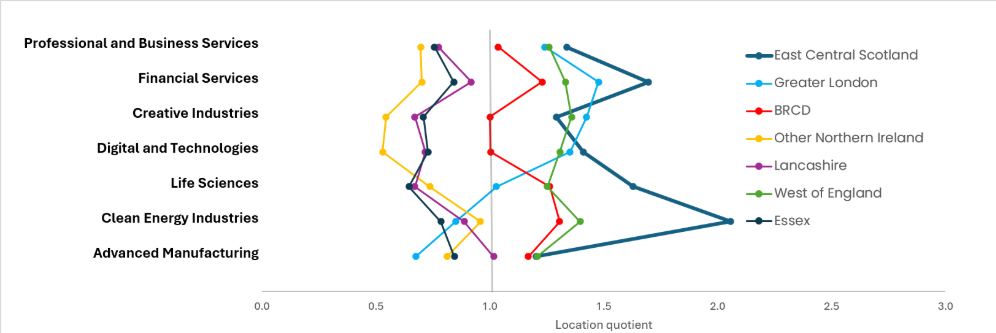
Figure 4 compares the BRCD area and the rest of Northern Ireland against similar areas, matched by how urban or rural they are. Two things stand out. First, like Other Northern Ireland, its comparators also have no specialism in any sector. Lancashire and Essex, also a mix of rural and smaller urban areas, show the same pattern. This is normal performance for such areas, as opposed to a sign of failure.
Second, the BRCD area lags its comparators in services sectors specifically. East Central Scotland (Edinburgh), West of England (Bristol) and Greater London all have stronger specialisms across most sectors. That gap is widest for the services sectors that most favour an urban location. So while the BRCD area – and Belfast in particular – is Northern Ireland’s services hub, there’s clear room to grow. That matters for what it contributes to both the Northern Irish and UK economies.
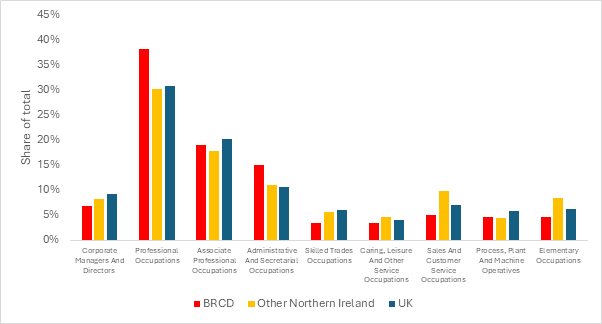
The BRCD area has few lower-skilled activities, but is also lacking in the highest-skilled ones too
An area can have plenty of Industrial Strategy businesses that mostly do low-skilled work. One way to check is to look at skills data, courtesy of Lightcast.
Figure 5 breaks down advertised jobs in these sectors by occupation. The BRCD area has a smaller share of jobs in the bottom five categories (to the right of the chart) than the UK as a whole. But that doesn’t translate into more high-skilled roles. The BRCD area beats the national average for Administrative and Secretarial jobs (particularly bookkeeping) and Professional Occupations (particularly accountants, nursing professionals, and programmers and software developers), but lags for Corporate Managers and Directors, and Associate Professional Occupations.
Growing the Industrial Strategy economy in Belfast (and by consequence, Northern Ireland) means more than just more jobs in these sectors; it means more higher-paid jobs too. A challenge for policy will be how to attract and grow more of these highest-skilled activities.
Get insights on your area through The Data City Platform
This kind of picture – sector strengths, local specialisms and skills gaps, as well as investment and spin out activity – is available for any part of the UK through our company-level dataset. Sign up for a free trial to see how your area performs.