




As an Industry Analyst at The Data City, I’m never short of finding innovative companies, especially when building or updating our Real Time Industrial Classifications. Web-text is an obvious way to understand each company’s innovative activities, but when updating our Agri-Tech and Net Zero RTICs I started to see how the granular pieces of information we have about each company on our platform can come together to form a complete image of how a company sits within a part of the emerging economy.
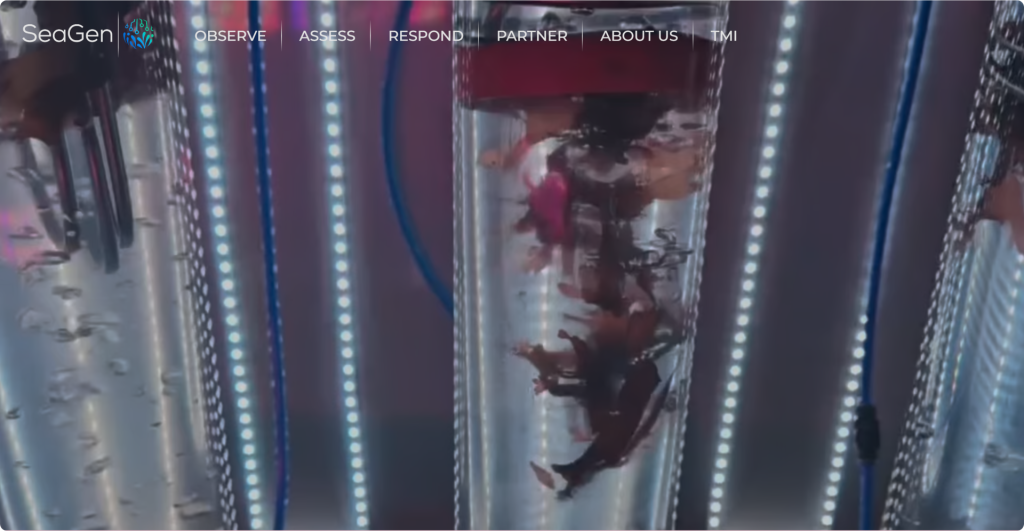
One of these companies is Seaweed Generation, or SeaGen. They’re a Cornwall-based company building AI and solar-powered marine robots to monitor ocean biodiversity and cultivate seaweed; both to absorb carbon from the atmosphere and to develop sustainable protein for animal feed. If you looked them up in a traditional business database, you’d find them filed under SIC code 03210: Marine Aquaculture or 01300: Plant Propagation. This is is technically accurate but almost entirely useless if you’re trying to understand their innovation, why they matter, or where they sit within the broader Net Zero landscape.
This is the problem with static industrial classifications. SIC codes were designed for a different era, and they simply can’t keep pace with the speed at which new industries emerge and existing companies evolve, especially in dynamic sectors like Net Zero. A classification system that can’t reflect that in real time isn’t just imprecise, it leaves entire types of companies invisble and absent from analysis.
Our RTICs work differently. Built with machine learning models trained on the language patterns of company websites, we automatically reclassify companies as their focus evolves. SeaGen is a perfect illustration of this in action. In late 2023, they gained global recognition for developing robotics to support marine carbon monitoring. With that, their website language shifted, and it shifted into exactly the territory we’d trained our classifier to detect.
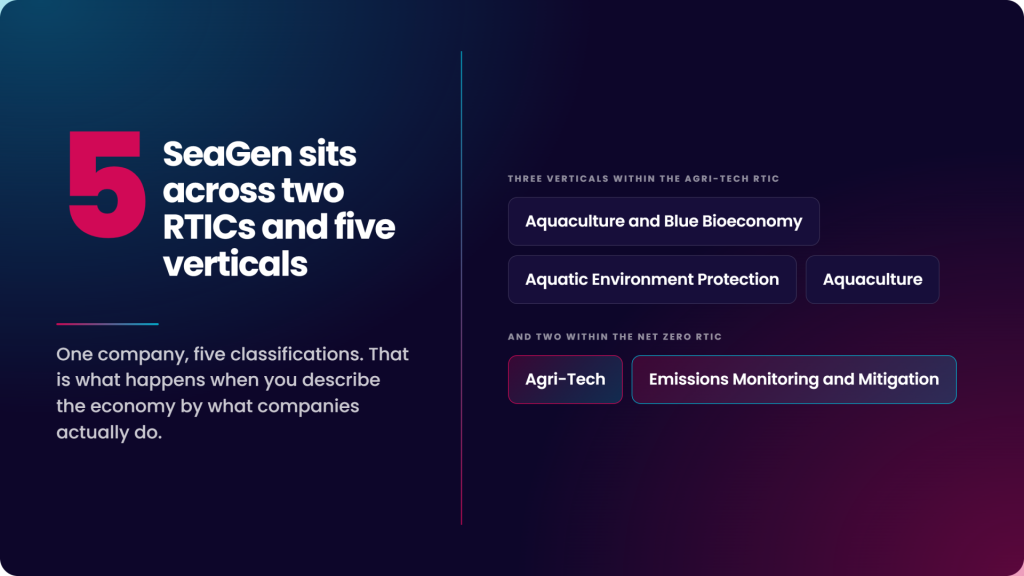
As a result, SeaGen now sits across five of our verticals, spanning Agri-Tech, and Marine and Maritime RTICs, as well as two verticals within Net Zero: Agri-Tech and Emissions Monitoring and Mitigation. That breadth makes complete sense for a company working at the crossroads of ocean science, carbon monitoring, and sustainable food systems, but it’s a image that a traditional SIC code simply couldn’t paint.
If we go beyond classification and look at the directors we find Professor Mike Allen, Co-founder and CSO of SeaGen, and an Associate Professor at the University of Exeter. Whilst a quick look on SeaGen’s company profile told me that Seagen aren’t an Exeter spin-out company, Mike’s research in marine biotechnology and algal genomics cements his company on the cutting edge of both academia and technological innovation. There’s also Duncan Smallman, another director who, through a quick search, sits on the advisory team at Eco Cascade: a seaweed processing company that we also have classified in our Agri-Tech RTIC under the Aquaculture and Blue Bioeconomy vertical. Where SeaGen is developing the cultivation technology, and one of their own directors is helping to connect the cultivator’s harvest output to commercial buyers, revealing a strategic relationship through just director names and classifications.
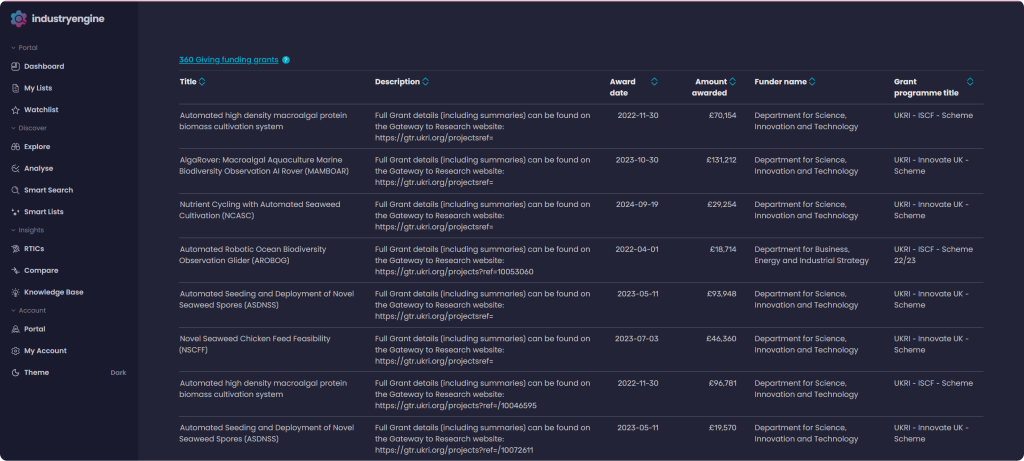
The funding picture adds another layer. We pull grant data from 360 Giving and Innovate UK together, and SeaGen’s grant history speaks directly to their mission. Their largest award, £291,616 from Innovate UK’s Farming Futures R&D Fund was for an automated high density macroalgal protein biomass cultivation system. That isn’t just a funding data point, it’s a window into what the company is prioritising, where they are in their development, and what problems they’re being trusted to solve.
If we move on from directors and look at SeaGen’s similar companies, we start to see how the companies carrying out similar activities are classified, and the adjacent RTICs they fall in to. As a quick overview, our similarity scores are based on a semantic level where an LLM-based analysis of website text is used, and a composite level where structured business characteristiscs like sector, location and employee data are used. As a company that cultivates seaweed for carbon removal, that builds autonomous marine robots and that monitors ocean biodiversity, any single-category similarity system applied to SeaGen would have to pick one and discard the rest. Our similarity engine doesn’t, and you can see that in who it surfaces.
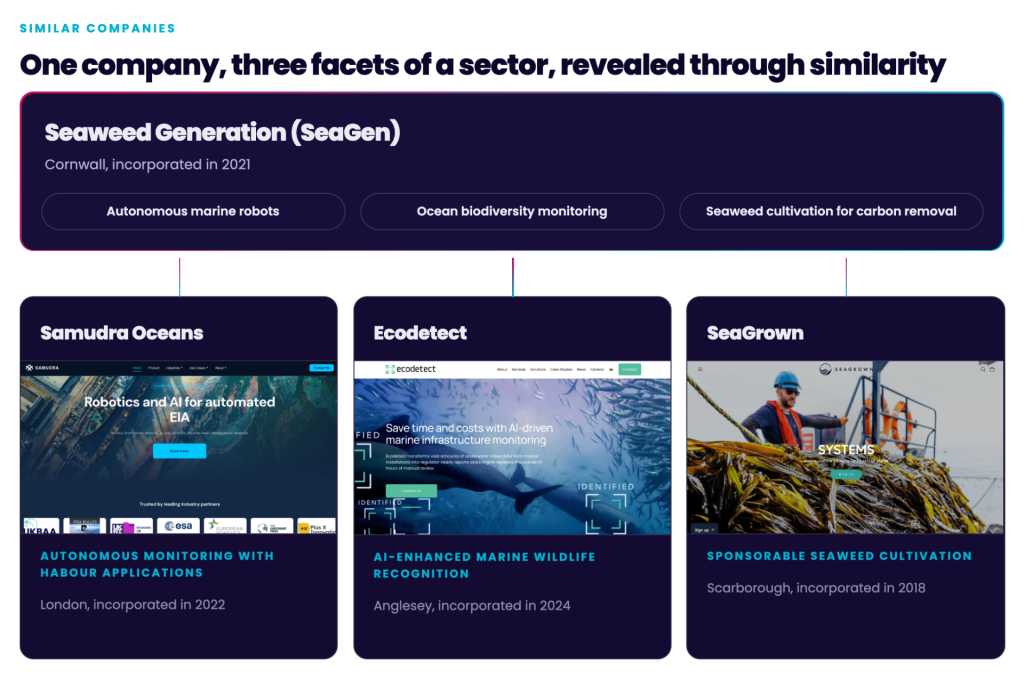
Take Samudra Oceans, based in London and incorporated in 2022 with the goal of scaling seaweed cultivation for carbon capture using AI and robotics. Whilst their autonomous subsea water quality monitoring system aligns them in technology and goals to that of SeaGen, hence their strong similarity score, Samudra also sells their data collection services to port operators, P&I clubs and marine underwriters for regulatory compliance. Using data on underwater noise limits and pollution liability evidence, they position themselves as providing the environmental baseline needed for better underwriting in a high stakes risk environment.
Ecodetect approaches things from another angle again. Based in Anglesey, they use underwater cameras and AI recognition to automatically identify marine wildlife like whales, birds, plankton, plant life that found around offshore infrastructure like wind farms and tidal arrays; speeding up environmental compliance analysis that woud ordinarily take months of manual work. Whilst serving different customers and applying unique technology that sees them also captured under the Image Processing vertical of our Artificial Intelligence Technologies and Applications RTIC, Ecodetect are solving the same problem as SeaGen: automated recognition of marine life from sensor data .
SeaGrown offers something the others don’t: scale. Incorporated in 2018 and based in Scarborough, SeaGrown operates England’s first large-scale commercial offshore seaweed farm in the North Sea and won a £2.8 million government contract in 2022 to develop new farming and harvesting techniques for biomass. With £6 million turnover and 37 employees, they’re the larger then the other similar companies, but developing a seaweed cultivation project that seeks to protect ocean environments and its biodiversity just as SeaGen are.
When looking at these three companies, we are looking at three different facets of Net Zero and Agri-Tech: automous marine robots, ocean biodiversity monitoring and seaweed culitvation for carbon removal. Before I even analysed the relationship between our Net Zero and Agri-Tech RTICs, I had a clear picture of how either sectors operate just through the company-level data available on our platform.
If you’re an investor mapping the blue-tech landscape, a policymaker trying to understand where the UK’s marine net zero capability sits, or a company looking for partners or competitors, this is the kind of view that changes what you can see.
Please note: Data from The Data City is accurate at the time the article was written but may change over time due to the dynamic, real-time nature of our data. For the latest insights, visit our platform.