





For the fourth year running, The Data City has helped power the ECIU and CBI Economics’ flagship net zero research – and this year’s findings are the clearest signal yet that the net zero economy is no longer a future story.
New research shows the UK’s net zero economy now underpins the jobs of 1.1 million workers, who together generate £105 billion in Gross Value Added (GVA) for the UK economy.
The race to net zero
The UK’s transition to net zero is reshaping the structure of the economy. What began as a decarbonisation challenge has become a system-wide economic transformation, influencing how energy is produced, how industries operate, and where economic activity is located.
This year’s research covers the UK as a whole, with additional reports published focusing on the strengths and opportunities in Scotland and Wales.
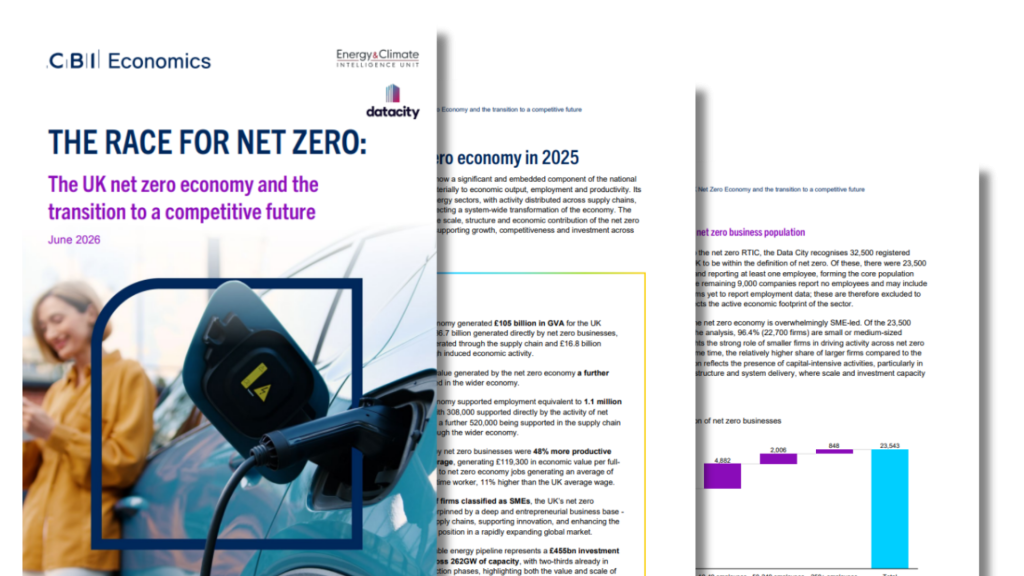
The lead report, ‘The Race for Net Zero: The UK Net Zero Economy and the Transition to a Competitive Future’, takes an in-depth look at the companies, sub-sectors and employees that make up the growing net zero economy in the UK, covering investment, job creation, wages, regional contributions and overall contribution to the UK economy.
The findings
The research finds that the UK’s net zero sector is a significant and embedded component of the national industrial base, generating value directly, through supply chains and into the wider economy, while supporting over a million full-time equivalent jobs.
- Scale of the economy – The net zero economy generates around £105 billion in GVA and supports 1.1 million jobs across direct activity, supply chains, and wider economic effects.
- Multiplier effects – For every £1 of direct value created, a further £1.85 is generated in the wider economy, reflecting deep integration across manufacturing, construction, professional services, and finance.
- High-value employment – Jobs in the sector are around 48% more productive than the UK average and come with an 11% wage premium.
- SME-led business base – The sector is underpinned by around 23,500 active companies, over 96% of which are SMEs.
- Geographic reach – Net zero investment is distributed across all regions and nations of the UK, with the sector carrying particular weight in Scotland, Yorkshire and the Humber, Wales, and the East Midlands.
- Investment pipeline – The energy infrastructure pipeline spans approximately 262GW of capacity and £455 billion of potential investment, with around two-thirds already in active development or construction.
Mapping the net zero sector
The net zero economy is exactly the kind of sector that traditional data misses. SIC codes, the classification system official statistics still rely on, are decades old and updated too infrequently to capture fast-moving industries. A solar charging infrastructure company, a sustainable aviation fuel producer, a climate-focused VC firm: all classified under broad, generic categories that tell you nothing about what they actually do.
That’s the problem The Data City was built to solve. CBI Economics first partnered with us in 2022 to define the net zero economy, using our Real-Time Industrial Classifications (RTICs) to identify companies that SIC simply can’t see. Built from real-time web data and machine learning, our net zero RTIC spans 14 sub-sectors – from Low Carbon and Renewable Energy Generation to Energy Storage and Agritech.
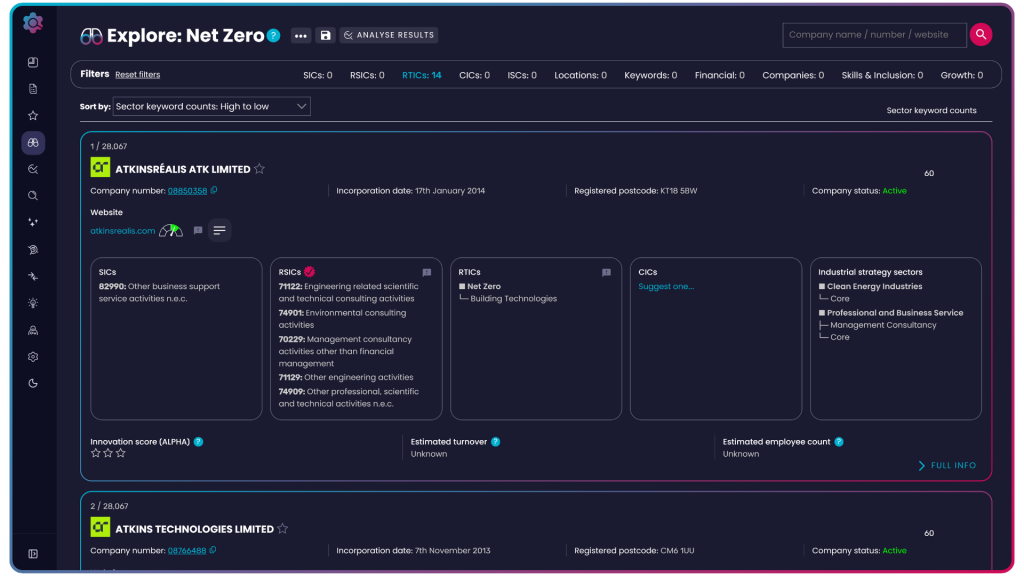
This year, the RTIC underwent its most significant update to date. We revisited the taxonomy across every vertical, expanding scope to reflect how the sector has evolved.
This included broadening the Low Carbon and Renewable Energy Generation vertical, expanding Green Finance to capture the full range of financial activity enabling net zero infrastructure, and extending Low Emission Vehicles beyond electric cars to include the wider industrial ecosystem driving the transition. The result is the most comprehensive version of the classification we’ve built, and the numbers in this report reflect that.
We’ve worked closely with CBI Economics every year since 2022 to refine the methodology and keep the taxonomy current. The result is a picture of the net zero economy that official statistics still can’t produce on their own.
See the data
Read the full research on the ECIU website.
The net zero RTIC and real-time insights on 23,000 companies in the sector are available on Industry Engine. Start a free trial today.