




Our Similar Companies feature just got a lot smarter. It used to match companies on their website text, which was great for finding businesses in the same space. Now it goes further, helping you find your real competitors and peers.
Our new similarity measure combines website text with key company features, like employees, locations and turnover, to make it possible to find true peers and competitors. We are not just suggesting companies that use similar language on their website, but companies that are also of a similar size and geographical spread of trading locations. In this blog, we tell you how.
Sounding alike is not the same as competing alike
Website text is still key to finding similar companies. How a business describes itself is one of the strongest clues we have about what it does. The catch is vocabulary. Company websites use marketing language that often includes common sector-specific keywords that help place companies in the same sector, but aren’t specific enough to find peers.
Adding extra company data to our similar companies feature helps. The new method still reads the website, but then asks three extra questions: are they in the same sector, are they a similar size, and do they have similar geographical reach? Let’s look at an example to see how these questions change the results.
Pfizer is an international pharmaceutical company with a large number of employees and trading locations. However, Pfizer’s website and a local pharmacy’s website can use the same words: medicines, patients, prescriptions, healthcare. A ranking that only reads the website has no reason to prefer another global competitor over a four-person pharmacy site. Both “sound alike”. But the local pharmacy is not a competitor. It just writes about the same world. But since website text was all we were using previously, Pfizer did get some local pharmacies as top results for our previous similar companies feature.
If we ask those three extra questions, Pfizer’s results look very different. GSK, AstraZeneca and Roche move up in the ranking, providing you with a list of real competitors of a similar scale and geographical reach.
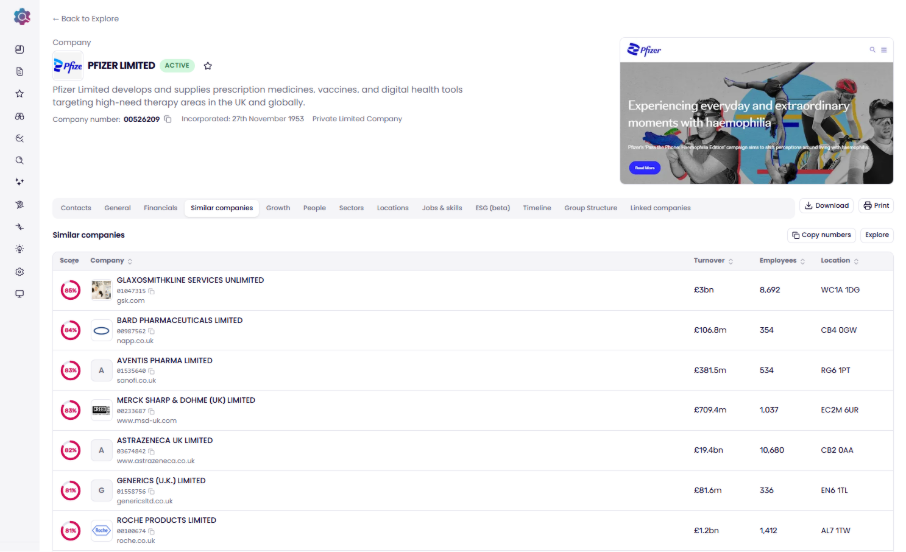
For you, this improvement means shortlists of real competitors and peer benchmarking that compares like with like.
The difference it makes
Bringing sector classification, size and geography into the classification method gets you 60% more true peers on the output lists. With website-only similarity, we were able to provide you with a good list that surfaced some real peers and competitors. With our new similarity measure, we are expanding the list of true peers and competitors you can access.
What it means for you
Use similar companies when you want a competitor shortlist, a peer set for benchmarking, or a first cut of a market map. You should spend less time removing businesses that only sounded similar on the website.
Website text is still doing the work it always did. We have just made our similarity feature better at finding companies that compete alike, not only companies that talk alike.
Try it on a company you know, sign up for a free trial.