





Is higher defence spending the answer for areas with struggling economies? Many think so, including the chancellor. But is it true? Now that The Data City has mapped the UK’s defence sector in association with ADS we can answer that question. The answer is, unfortunately, no.
Defence companies locate in some places more than others
Defence companies exist in every part of the country. But they concentrate in some places more than others. Figure 1 splits local authorities into three groups according to the strength of their economies: low productivity, medium productivity and high productivity. It shows how well they perform on three metrics: share of UK population, share of companies that operate in defence, and the share of the most innovative defence companies.
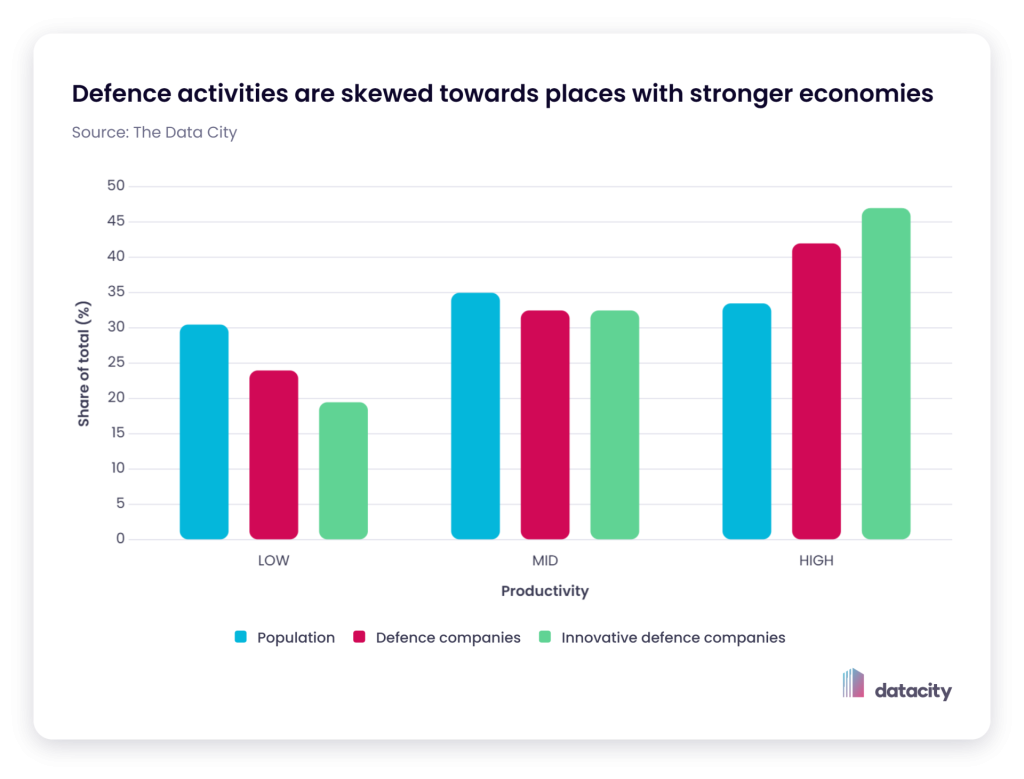
In terms of population they are evenly split, with around a third of population falling into each group. But this changes when looking at the locations of companies that operate in defence. Overall they cluster in higher-productivity areas — and for the most innovative companies this is stronger still: the most productive local authorities are home to almost half of the UK’s most innovative defence-related firms.
This pattern reflects what defence companies look for in a location. The chart above suggests that defence companies, and the most innovative ones in particular, are drawn to the same places by the same factors as innovative companies in other sectors.
Exceptions happen, but they are rare
There are exceptions to this. Cumberland is one. It is home to 0.4% of population but 0.7% of companies that operate in defence. This is likely influenced by a number of Ministry of Defence sites in the area. Somerset, with a history of aircraft production at Yeovil, is another.
So, it’s not impossible that specific places can break this pattern, as Cumberland has. And assessing how many defence companies (or indeed those that could easily move into defence) are in any one area is sensible given the changing patterns of defence spending and any uplift this might create to the local economy.
Tackling subnational economic divides require serious thought backed with data
But we should be careful about sweeping statements to address a thorny problem. Defence is not the first sector to be offered as the solution to the economic challenges of struggling areas. Before it was data centres. And before that was Net Zero. There is a pattern here.
Simply hoping that any one sector will bring prosperity to struggling areas is not a policy. Real answers require serious thought about what drives the location decisions of 21st-century businesses, what policy can do to support this, and how best to connect people to the prosperity these businesses generate.
To do this we need good quality data. If you’d like to know more about The Data City’s data on the defence sector, sign up for a free trial or book a 121 demo today.