




Agricultural technology encompasses the science of what we grow, the inter-dependent systems through which we grow it, the engineered machinery that makes that possible at scale, the natural environments that sustain it, and increasingly the materials that biological innovation can produce from it.
The Data City’s UK Agri-Tech Real-Time Industrial Classification (RTIC), built over the past year in partnership with the UK Agri-Tech Centre, is structured around that breadth. RTICs are The Data City’s alternative to outdated standard industrial classifications – built in real time from what companies actually do, rather than outdated SIC codes.
The Agri-Tech RTIC contains 12 verticals, the granular categories that define what a company does, and can be understood as a combination of 5 clusters, within which these verticals are grouped according to the type of activity they capture.
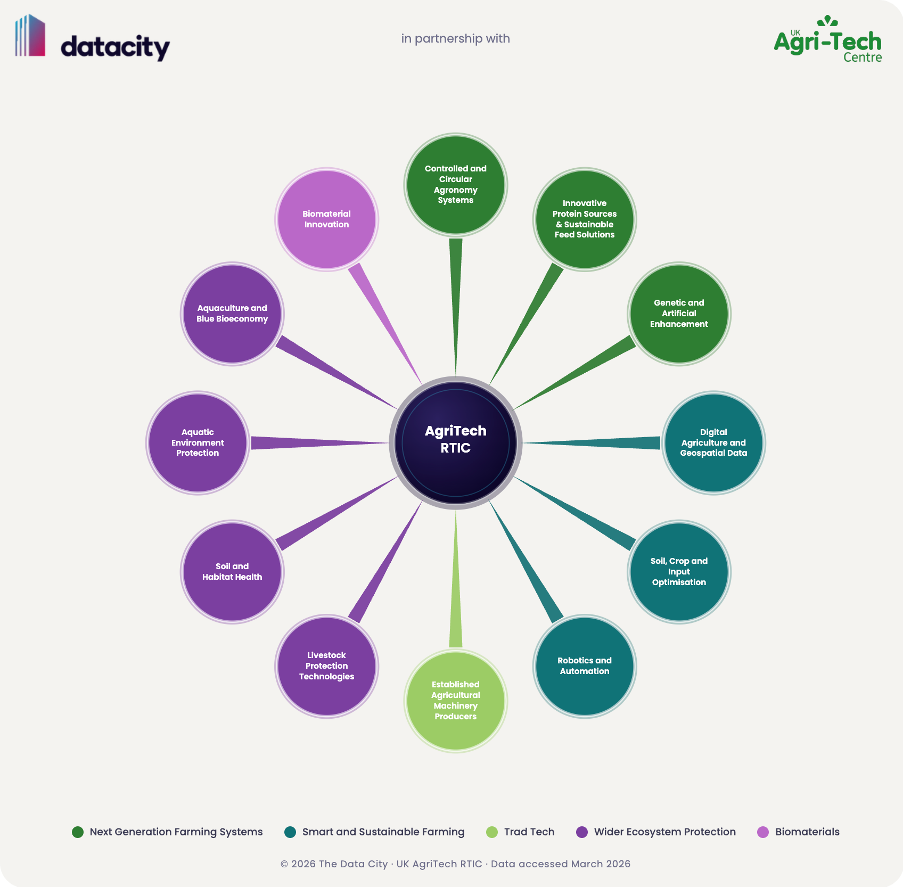
The first, Next Generation Farming Systems, covers companies reimagining the fundamental processes of food production through controlled environments, novel protein sources, and genetic science. The second, Smart and Sustainable Farming, captures the digital and mechanical layer being applied to existing agricultural practice: the sensors, platforms, robots, and machinery that make conventional farming more precise and less wasteful.
Trad Tech, the third cluster, recognises that despite being more established than the start-ups populating the other clusters, large-scale agricultural machinery manufacturers remain central to the sector’s incremental innovation effort. The fourth cluster, Wider Ecosystem Protection, is the most expansive: it brings together companies working on livestock health, soil and habitat restoration, aquatic environment monitoring, and sustainable aquaculture, reflecting the degree to which modern agricultural technology is inseparable from the ecological systems it depends on.
The fifth, Biomaterials, covers companies developing sustainable materials from biological sources, applying biotechnology across manufacturing, packaging, and consumer products. Across these five clusters sit twelve verticals and a set of companies that together make up a comprehensive map of how and where the UK’s Agri-Tech sector is either innovating.
Next Generation Farming Systems
The cluster most people associate with Agri-Tech’s cutting edge is what we’ve called Next Generation Farming Systems: companies finding radically different ways to grow food. LettUs Grow, a Bristol-based company developing aeroponic indoor growing technology, sits within the Controlled and Circular Agronomy Systems vertical, and are spearheading how growing plants in misted air environments can be scaled to create controlled food systems in the UK.
In the same cluster and found in the Innovative Protein Sources & Sustainable Feed Solutions vertical is Entocycle: providers of precision insect farming technology, including automated breeding systems and monitoring equipment, enabling operators to convert organic waste into high-protein animal feed at scale. Alongside the companies in this vertical that are pioneering circular solutions to protein supply sits the Genetic and Artificial Enhancement vertical. Exemplifying this vertical, Biographica applies machine learning to crop genomics, identifying high-value genetic targets for gene-editing to develop crops that are more productive, nutritious, and resilient to worsening climate condition
Smart and Sustainable Farming
More aligned to established farming methods, the Smart and Sustainable Farming cluster covers the technologies being applied to existing farmland, or those involved in the monitoring, optimisation, and automation layer on top of conventional agricultural practice. Exemplifying the Digital Agriculture and Geospatial Data vertical, Pro AgroTech integrates IoT sensor technology and drone-based spraying systems to give farmers more precise, data-driven control over pest management and crop protection inputs.
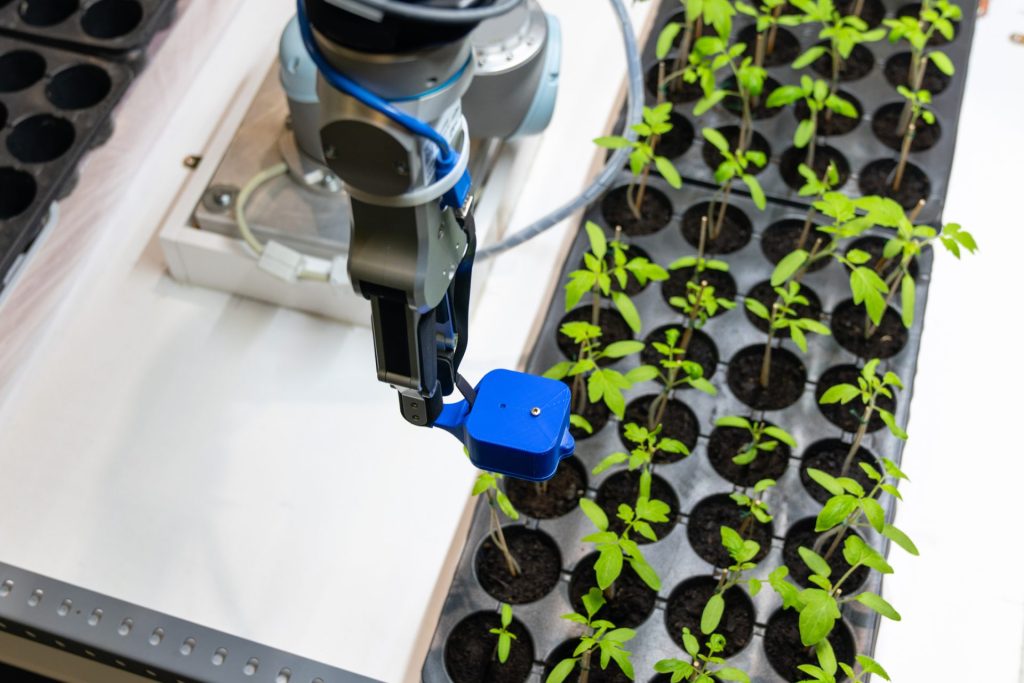
Companies found in Robotics and Automation vertical, such as Earthrover, build autonomous field robots for tasks such as precision weeding, or those that use smart targeting to remove the need for chemical inputs like herbicides. Defining the Soil and Crop Input Optimisation vertical is the idea that the enhancing of what goes into the ground is as consequential as the technology that monitors it from above. Yara, one of the world’s largest crop nutrition companies and a company classified here, has built its position not only on innovating fertiliser production but on the development of digital tools that help farmers apply inputs with greater precision and with less waste.
TradTech
Amazone, another major sector player, is a manufacturer of precision seeding, fertilising, and crop protection machinery, and characterises Established Agricultural Machinery Producers. A vertical found in its own cluster, it captures the companies that are driving sectoral change through successive generations of engineering refinement rather than through disruption.
Wider Ecosystem Protection
Then there is a cluster the original taxonomy had no framework to capture: Wider Ecosystem Protection. This is perhaps the most significant expansion, and the one that most clearly reflects how the definition of Agri-Tech has had to evolve to capture the broader ecological systems that underpin agricultural productivity. The Pirbright Institute, one of the world’s leading research centres for livestock viral diseases, exemplifies the Livestock Protection Technologies vertical and companies developing vaccines and diagnostics for the diseases that can devastate agricultural production at scale. Within this cluster also sits the Soil and Habitat Health vertical where companies like BIAS Labs specialise in the supply of invertebrate organisms and ecotoxicological testing services that are needed for advanced ecological monitoring and soil health testing.
The aquatic environment and blue bioeconomy verticals within this cluster are where the taxonomy breaks most cleanly from conventional definitions of Agri-Tech. Characterising the former vertical is the Plymouth Marine Laboratory and their ocean monitoring and marine ecosystem intelligence that powers insights around food security and environmental sustainability. Characterising the latter vertical and its group of companies producing high-value bioactive compounds from marine sources is Kelp Crofters: a small-scale team based in the Isle of Skye that are cultivating native kelp to create plant growth stimulants.
Biomaterials
The final cluster is Biomaterials and whilst the connection to agriculture is less obvious than the others previously mentioned, its role is important, for the agricultural supply chain depends on packaging, materials, and inputs, and the companies finding biological routes to those materials are as much a part of the sector’s future as those working on seeds or soil. As an example, Polymateria, based in London, uses their biotransformation technology to turn plastic into a wax-like substance that is then consumed by microorganisms, leaving no microplastics to enter food supply chains.
Understanding the shape of modern Agri-Tech
When viewed together, these 5 clusters and their verticals make up a sector view that wouldn’t been possible without the insight from The UK Agri-Tech Centre. What the project’s conclusion and our taxonomy revision makes clear, above all, is that the sector’s boundaries run parallel and intersect with biology, computation, ecology, and materials science. Keeping these boundaries real-time and cutting-edge matters both for the companies themselves, who need to be findable by investors, policymakers, and collaborators, and for anyone trying to understand what the UK’s position in global agricultural innovation really looks like.
To explore this RTIC and those that it intersects with, sign up for a free trial here.