





A central part of the future success of the sectors the Government has picked to target in its Industrial Strategy will be whether they can get the skills they need. Combining our definition of these IS-8 sectors with data on skills that they ask for in their job adverts (courtesy of Lightcast) allows us to do this for the very first time. Here is what it shows.
There’s little difference in the most in demand skills across the IS sectors
The most striking thing is that the skills most in demand are pretty common across the sectors, despite their apparent differences in what they do (see Table 1). Business skills are in the top three most in demand set of skills to appear on job adverts over the last five years for every sector, as is the case for the economy overall. Skills that fall under this category accounted for at least one in five of all skills requested for every sector. Information technology appears in the top three for six of the sectors too, while Finance appears for three of them.
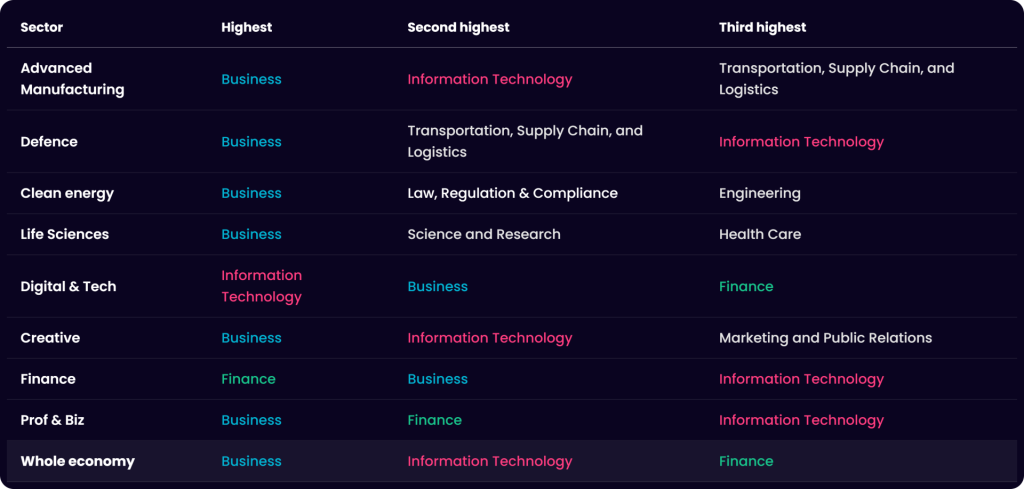
Breaking the category of ‘business’ down further shows that different sectors are also looking for similar types of business skills. ‘Project Management’ is the most popular across all sectors, followed by ‘Process Improvement and Optimisation’ and ‘Business Analysis’.
There are sector specific differences, but they account for small shares of the total
There are of course some differences between sectors. Many of these aren’t surprising, for example:
- Over a quarter of Finance jobs advertise specifically for finance skills. But around half of these are for ‘general finance’ rather than anything more specific.
- Over a sixth of Life Sciences adverts require science and research skills – other sectors rarely ask for these skills.
- IT skills are much more in demand in Digital and Technologies than other sectors – double that for Finance and Advanced Manufacturing (the next highest sector).
- One in every 10 skills in job adverts in Creative Industries was for marketing and public relations, at least twice the level of any other sector.
Sector tags sometimes don’t give a good guide as to what businesses are actually doing
On the face of it, one of the most surprising findings is that Advanced Manufacturing has the third highest demand for IT skills (16%) of any sector – higher than the services-based Professional and Business Services.
This reveals the nature of modern manufacturing in the UK – there is a strong services bent to its activities. Just a quarter of skills requests from Advanced Manufacturing companies were in engineering, manufacturing and production, transportation, supply chain, and logistics combined. There isn’t as much manufacturing in Advanced Manufacturing as you may think.
This suggests that overall different sectors are broadly looking for the same things
High-skilled businesses will need high-skilled workers. And so understanding what skills interventions the Government may need to make to support its Industrial Strategy is likely to be an important factor in its success. The analysis here shows that in most instances there are large similarities in skills demand between sectors. While there are specifics in each sector, these tend to account for a small share of the total.
There is always a temptation when naming specific sectors in a strategy to create sector-specific interventions. The individual sector plans released under the Industrial Strategy illustrate this. The analysis above suggests though that for skills at least, the sectors are largely looking for the same thing.
This is just a summary but with a Lightcast add-on subscription you can dig deeper into the data. Sign up for a free trial.