




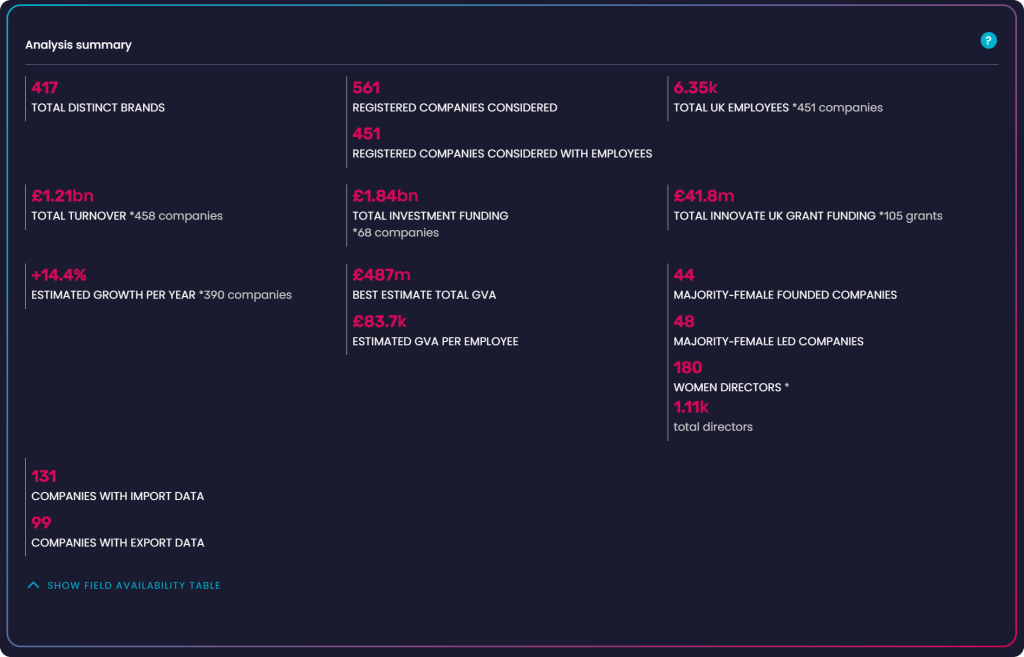
An RTIC, or Real-Time Industrial Classification, is The Data City’s alternative to standard industrial classifications like SIC codes. Instead of fixing companies into categories that get reviewed once every decade or two, RTICs are built and maintained continuously from what companies actually do, using live company data rather than static registrations. That means a classification can be redrawn as a sector matures, exactly as it has been here.
Extended Reality (XR) is the umbrella term for technologies that blend digital content with the physical world or replace it entirely: virtual reality (VR), augmented reality (AR), and mixed reality (MR). What ties them together is how the experience reaches the person, not the industry it’s used in. A VR headset works the same way whether it’s training a surgeon or running a game.
A sector that’s grown up
Immersive technology spans an unusual amount of the economy for a sector so young: surgeons rehearsing procedures in VR, construction engineers positioning steelwork through headsets accurate to the millimetre, fashion brands letting customers try on products through their phone cameras, and audiences standing together inside projection domes watching worlds assemble around them.
The Data City’s RTIC for this sector has been rebuilt to reflect how that economy has matured. The Immersive Technologies RTIC is now Extended Reality and Other Immersive Technologies, a restructuring, not a replacement. The companies driving the sector’s innovation are still here. What’s changed is how the classification is organised, and how precisely its boundaries are drawn. Keeping an RTIC current sometimes means rebuilding the map, not just the lists.
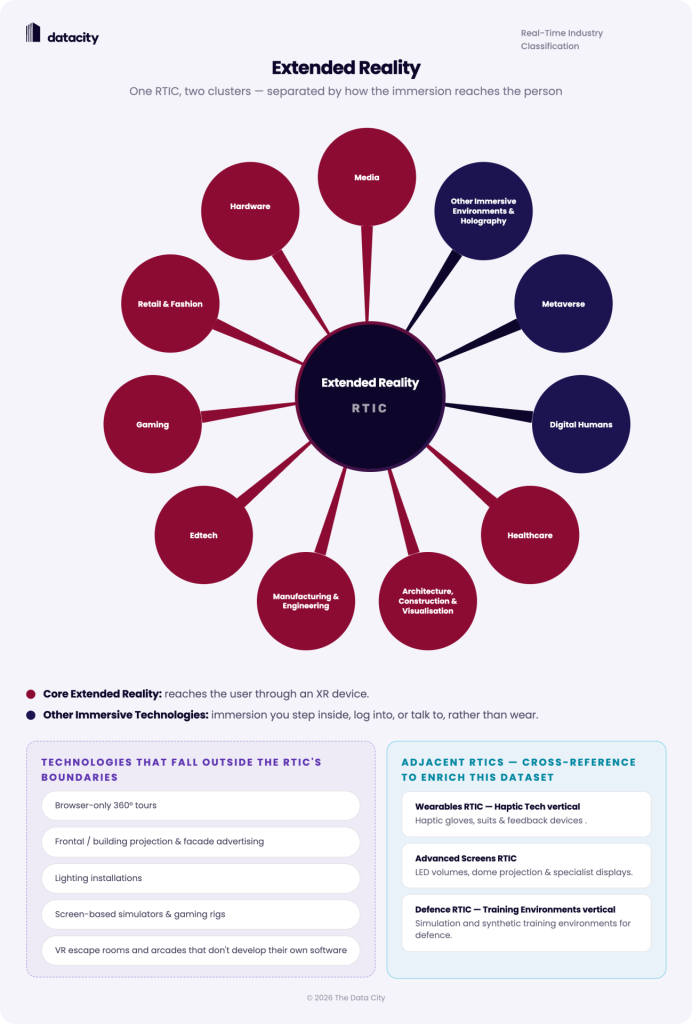
The new RTIC has two clusters, separated by a single question: how does the immersion reach the person?
How vertical boundaries were redrawn
The previous version of the Extended Reality RTIC mixed two kinds of vertical. Some described industries: Healthcare, Gaming, Media. Others described technologies: Virtual Reality, Augmented Reality, Mixed Reality, Haptics, 360°. That structure served the sector well when the technologies themselves were the story. But it created a growing problem: a VR surgical training company belonged simultaneously to “Virtual Reality” and “Healthcare”, while the technology labels accumulated companies whose only connection to immersion was the word itself.
The restructure retires the technology verticals and makes every Core vertical an industry. The companies building VR, AR and mixed reality products haven’t gone anywhere. They’ve been rehomed into the industry verticals they actually serve. In their place, one technology test now runs through the whole Core wing: does the product reach its user through an individual XR device, whether that’s a VR headset, AR glasses, phone-camera AR, or mixed reality? That framing isn’t ours alone. It reflects the settled consensus in the academic literature and UK policy precedent, where extended reality is the umbrella for VR, AR and MR, and immersion is understood as a property of how content is delivered, not how it’s described.
Haptics, the remaining technology vertical, has found a more natural home: haptics companies now sit in the Haptics vertical of our Wearables RTIC, alongside the body-worn technology they belong with. Other adjacent RTICs that intersect with Extended Reality are Advanced Screens and the Training Environments vertical that sits within our Defence RTIC.
Explaining the companies that left
Tightening a definition means some companies no longer qualify. Notable examples include 360° property tours, LED screen manufacturers and virtual production studios that might develop immersive tools or services but do so without an explicit mention or use of the core XR technologies. The new taxonomy resolves each of these patterns with an explicit, checkable rule around technology rather than a judgement call. As an example, simulators delivered through VR headsets qualify, whilst screen-based rigs, however spectacular, do not. Without that line, one wraparound gaming rig would justify the next, and the classification would gradually refill with exactly the screen-based hardware the definition exists to distinguish.
Nothing has been deleted from The Data City’s database in the process: companies that left this RTIC remain fully searchable, keep all their data, and appear in the other adjacent RTICs they qualify for. What’s changed is what membership here means.
Core Extended Reality
The Core wing holds the industry verticals where products reach their users through an individual XR device.
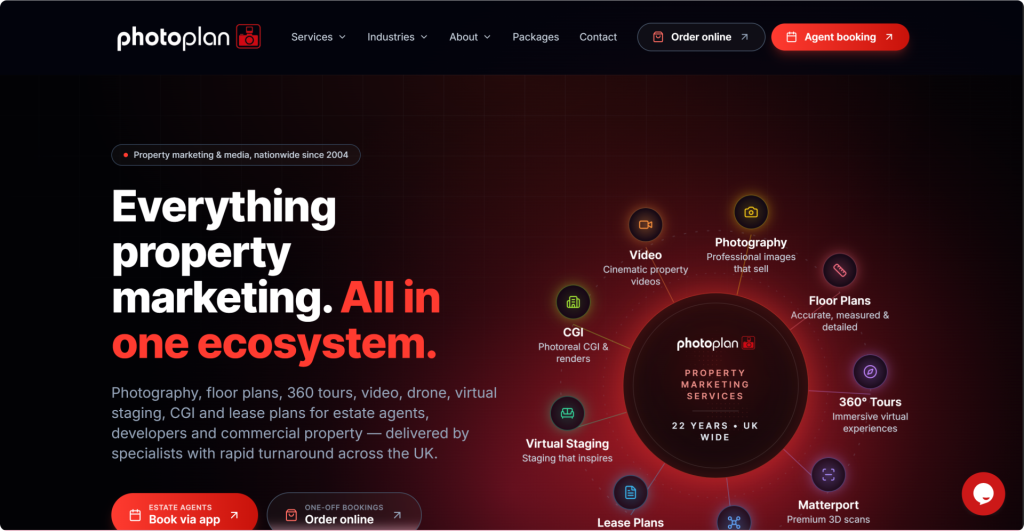
The clearest illustration of the new precision is the merged Architecture, Construction and Visualisation vertical, which replaces the old 360° and Architecture & Construction verticals. Its membership test is the most explicit in the RTIC: a 360° tour company qualifies only if it states VR delivery on its own website. XYZ Reality exemplifies the vertical’s engineering end. Its AR headsets let construction teams position work against the design model in real time. Photoplan shows the property end done right, with a fully branded Meta Quest tour viewer on top of its capture business.
In Healthcare, Strolll delivers augmented reality neuro-rehabilitation therapy through AR glasses, and Oxford Medical Simulation provides VR clinical training used by health systems internationally.
Gaming retains the studios that have defined UK VR development, including nDreams, one of the world’s largest VR-specialist game developers, alongside AR game makers like Triangular Pixels.
In Manufacturing & Engineering, Avatar Partners builds XR software for industrial training and maintenance, and Gravity Sketch uses VR to create immersive workspaces.
Media is the largest vertical and holds the sector’s storytellers: Draw and Code create AR and VR brand experiences, while Animotive innovates film productions with XR technology.
Retail & Fashion captures companies like BinaryCloth, whose beauty division builds AR try-on experiences for global brands, and Visionthree, whose platform lets brands showcase products immersively using AR.
EdTech covers immersive learning specialists such as Pauley and Avantis Education. And Hardware anchors the wing with the physical technology itself: Specs‘ advanced AR glasses.
Immersive Technologies
The second cluster exists because some immersive technology doesn’t reach people through an individual device, but through shared physical environments, persistent virtual worlds, and digital beings: immersion you step inside, log into, or interact with, rather than wear or hold.
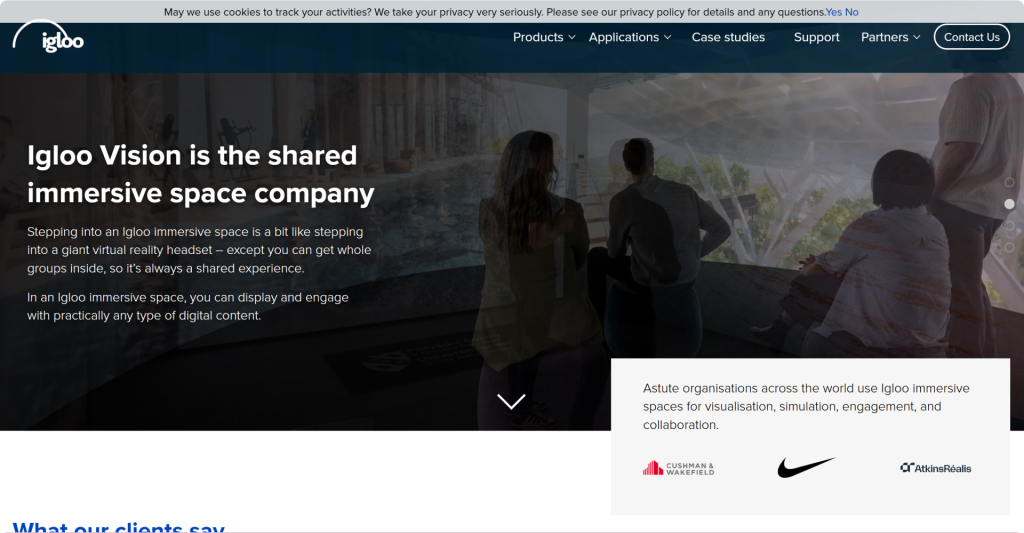
Other Immersive Environments & Holography captures shared immersion: audiences together inside projection domes, immersive rooms and 360° screen environments, or sharing space with volumetric and holographic content. Igloo Vision, whose shared immersive spaces are used across industry and education, is the emblematic company here, and an instructive one, holding dual membership with Hardware because it both builds the technology and delivers the environments. 4Pi Productions shows the creative end, producing immersive dome content from its Cardiff studio.
Metaverse covers persistent, shared virtual world platforms and their infrastructure: immersion through presence in a world, whatever the screen. MetaGravity exemplifies the deep-infrastructure end, building simulation technology designed to let virtual worlds host millions of concurrent users.
Digital Humans, a new vertical, captures the fast-growing companies creating AI-driven avatars and virtual beings, from Charisma’s interactive character engine to Colossyan and Yepic AI’s avatar video generation platforms.
What this restructure means
Together, these two wings and their verticals form a sector view that was only possible by rebuilding the classification one company at a time, against a definition rooted in academic research and UK policy. That rigour is what gives the new lists their value: the harder a list is to join, the more being on it means. For the companies inside, inclusion is now a genuine credential. For investors and economic-development teams, it’s a reliable way to find the companies building extended reality technology, not just using it.
To explore the Extended Reality RTIC, sign up for a free trial.
Please note: data from The Data City is accurate at the time the article was written but may change over time due to the dynamic, real-time nature of our data. For the latest insights, visit our platform.