





The British Beauty Council’s recent call for urgent SME reform highlights a growing frustration across the UK economy. Innovative businesses are building new sectors, creating jobs and driving exports. But when it comes to recognition and support, too many of them simply do not exist in the eyes of the system.
Why? Because the system still relies on SIC codes.
The problem: if you can’t see it, you can’t support it
Standard Industrial Classification codes were last meaningfully updated in 2007. Since then, entire industries have emerged, converged and scaled. AI, FinTech, CreaTech, Engineering Biology… The list grows every year, yet support schemes, grant eligibility, tax reliefs and even economic impact assessments still lean on SIC codes to define “who counts”.
SIC 2026 is on the horizon and reform is welcome. But even with revisions, SIC will remain a static classification system. It will still require businesses to choose a primary activity, and it will still be updated in cycles measured in years, not months.
That creates three structural problems.
1. Emerging industries don’t have a code
When a new industry forms, there is rarely a dedicated SIC code for it. Businesses default to broad or adjacent categories such as:
- Other business services not elsewhere classified
- Activities of head offices
- IT services
This means frontier sectors appear smaller than they are and when policymakers assess sector size, growth or employment, they are often looking at the wrong picture.
In our discussion paper Open Sourcing the Industrial Strategy, we set out clearly that SIC codes are backwards looking and outdated. That is not a minor inconvenience, it fundamentally limits the government’s ability to measure and support growth sectors.
If measurement is flawed, support will be too.

2. Converging sectors are invisible
Modern industries don’t fit neatly into one box.
Take FinTech. Is it finance? Is it technology? Under SIC rules, it must be one or the other. But in reality, it is both.
The same is true for:
- CreaTech: creativity + technology
- ClimateTech: energy + engineering + digital
- BioTech platforms: life sciences + AI
SIC forces companies to declare a single “primary activity”. The modern economy does not work like that.
As we highlight in our Industrial Strategy work, SIC codes struggle to define sectors that are the application of two or more industries. The result is distortion. Companies operating at the cutting-edge fall between categories, and when support is allocated by category, they fall between funding streams too.
3. Self-declared codes distort reality
Companies choose their own SIC codes when registering at Companies House. Many select vague options such as “activities of head offices”. Others fail to update codes as they pivot or scale.
Government itself acknowledges that this complicates analysis and makes it difficult to understand what firms actually do.
Now imagine building SME support around that data.
If eligibility criteria depends on self-declared, outdated, and often inaccurate classifications, entire groups of innovative SMEs are excluded from meaningful support. Not because they lack potential. But because the system cannot see them clearly.

The cost of invisibility
When sectors are undercounted or misclassified:
- Grant funding misses high-growth firms
- Tax incentives fail to reach target industries
- Regional growth strategies overlook emerging clusters
- Policymakers underestimate sector size and impact
- Trade bodies struggle to evidence economic contribution
In our work mapping the IS-8 sectors, we show that some government sector definitions have low confidence because appropriate SIC codes do not exist. If a sector cannot be defined properly, how can it be supported properly?
That is the structural issue at the heart of SME reform.
The SIC code crisis: Real-world consequences
The limitations of SIC are not theoretical. They are already creating measurable harm across the UK economy.
Outdated and misapplied classification systems have contributed to regulatory failures, financial penalties, systematic bias and widespread economic blind spots.
Since 2012, UK banks have been fined more than £740 million for AML failures where inadequate business classification and customer due diligence were contributing factors. In several high-profile enforcement cases, firms were incorrectly classified, risk ratings were misapplied, and evolving business models were not properly captured. When classification is wrong at the point of onboarding, the entire downstream compliance infrastructure operates on flawed assumptions.
The issue extends beyond financial crime.
Approximately 740,000 UK companies (around 15% of all incorporated businesses) are currently registered under “not elsewhere classified” (n.e.c.) SIC codes. These catch-all categories provide virtually no insight into what companies actually do. Frontier sectors, including Net Zero, Advanced Manufacturing and Modular Construction, are materially undercounted as a result.
There is also evidence of structural bias. Research from Censhership shows that women’s health businesses have faced consistent barriers accessing financial services due to classification-based risk flagging. Many have been miscategorised as “adult content” or “high risk” because the classification infrastructure has no meaningful provision for FemTech or women’s health innovation.
Digital assets provide another live example. A recent industry survey found that approximately 40% of cryptocurrency transactions to exchanges are being blocked or delayed by UK banks applying blanket classification-based restrictions. This is happening despite the government’s stated ambition to position the UK as a digital asset hub.
Even government has acknowledged the problem. Official commentary recognises that SIC codes provide limited insight into critical sectors including the green economy. Yet these same codes continue to underpin SME support schemes, industrial strategy mapping, and eligibility criteria.
This is the classification crisis.
It is not simply that SIC is outdated. It is that reliance on static, self-declared codes is actively distorting regulatory systems, financial risk models, industrial policy, and access to capital.
If we are serious about SME reform, this is not a marginal technical issue. It is core economic infrastructure.
And infrastructure that misclassifies reality will inevitably misallocate support.
A better way to classify what companies actually do
The solution is not more surveys. It is better data infrastructure.
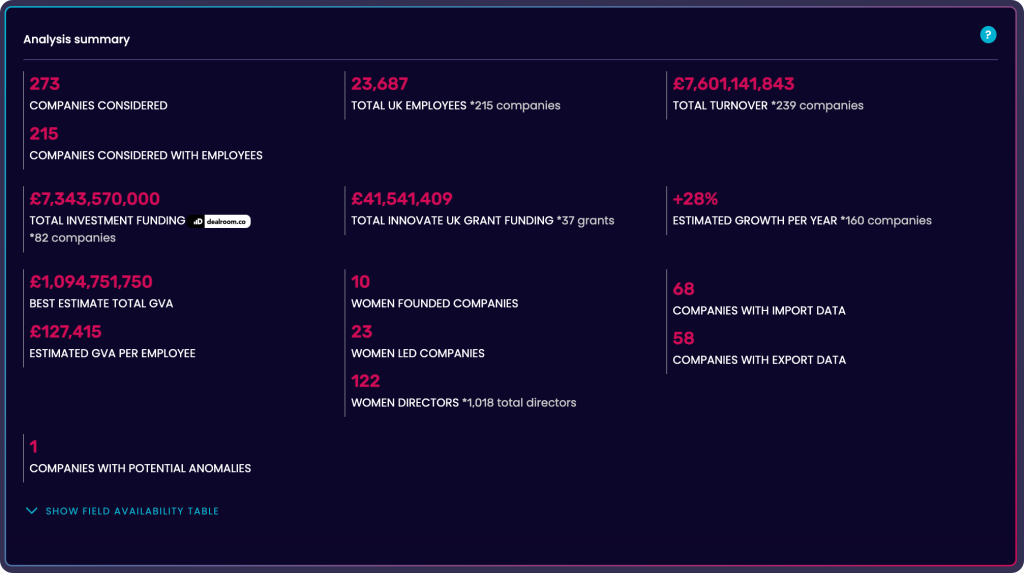
At The Data City, we classify companies based on what they actually do, not what they declared in 2007. We use website text, machine learning and expert input to build Real-Time Industrial Classifications (RTICs) that reflect the modern economy.
This approach allows:
- Clean Energy companies to be identified even without a Clean Energy SIC
- AI companies to be measured even if they chose “IT consultancy”
- Defence businesses with dual civil applications to be properly mapped
- CreaTech firms to be identified across creative and digital boundaries
As outlined in our discussion paper, this enables frontier sectors to be defined and tracked in a way traditional systems cannot.
And once you can see them clearly, you can support them intelligently.
SME reform starts with measurement reform
The British Beauty Council is right to call for reform that reflects the reality of modern SMEs. But meaningful reform requires structural change.
If sector definitions remain anchored to outdated SIC codes:
- Funding will lag innovation
- Policy will trail the market
- Emerging industries will remain underrepresented
Clarity is not a luxury in economic policy. It is the foundation.
We cannot build an Industrial Strategy, a growth plan, or meaningful SME reform on a classification system that predates smartphones.
The UK has world-class entrepreneurs building world-class companies in sectors that barely existed a decade ago. They should not be excluded from support because they sit in the wrong statistical box.
We don’t need to tweak SIC, we need to move beyond it.
That is how we ensure the next generation of SMEs are visible, measurable and properly supported.
Want to get stuck in right away? Sign up for a free trial or get in touch with us to discuss a research project.