




We’ve rebuilt the EdTech RTIC in collaboration with two expert organisations who live and breathe the sector. Real insight, straight from the source.
The new EdTech collaborators
First, The Department for Education (DfE). Bringing deep knowledge of how digital tools are used across schools, colleges and training providers.
Second, PUBLIC.io. A digital‑transformation company that helps governments modernise services. PUBLIC works across procurement, digital strategy, online safety, local‑government innovation and digital‑skills development. And although they’re not an EdTech firm, their position between policy, procurement and technology, and their close links with government and start-ups, gives them real influence over how digital‑learning tools are chosen and rolled out across the public sector.
Together, they helped us shape a clearer, more accurate definition of what EdTech looks like today.

Why this matters
EdTech is one of the UK’s fastest-growing sectors, but it’s invisible in traditional data.
There’s no dedicated SIC code for EdTech, and the ones that do exist are too broad to be useful. They group wildly different companies together, meaning it’s impossible to get a clear view of the EdTech ecosystem. You can’t support what you can’t see.
That’s where Real‑Time Industrial Classifications (RTICs) come in.
RTICs are The Data City’s alternative to SIC codes. Instead of relying on outdated SIC codes, we use real‑time data from company websites and digital signals to understand what a business actually does. This makes it far easier to identify emerging and fast‑changing sectors like EdTech.
With the DfE and PUBLIC helping us to define the boundaries of the sector, we have built a detailed, up‑to‑date map of UK EdTech. The EdTech sector is focused only on solutions for schooling years 1-13. It reflects what the industry looks like right now.
What the updated EdTech sector looks like
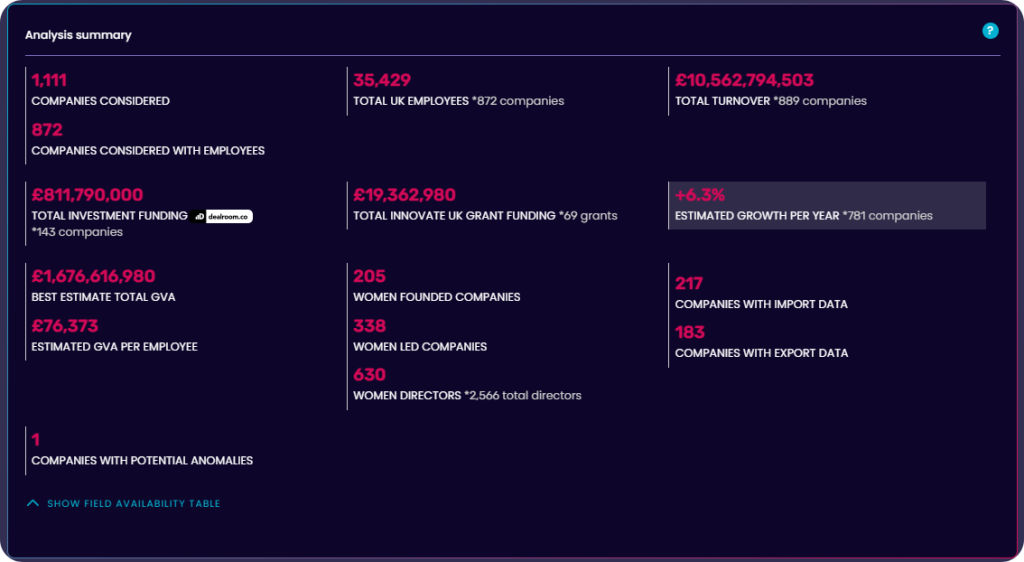
The updated EdTech RTIC reveals a fast-growing, high-impact sector. Across 1,111 UK companies, we identified over 35,000 employees and a combined turnover of £10.56 billion. These companies contribute an estimated £1.68 billion in GVA, with £76,373 generated per employee. Growth is strong too, with an average annual increase of +6.3%. Funding is flowing into the sector, with £811.8 million in investment across 143 companies and £19.4 million in Innovate UK grants.
Below are the verticals (subsectors) used in the updated EdTech RTIC, shaped with DfE and PUBLIC to ensure the definitions are accurate, the categories are distinct, and the boundaries are clear.
1. Foundational learning & content platforms
The core digital infrastructure and content delivery mechanisms that support education including tools like learning platforms and content repositories that help distribute materials and manage learning at a basic level.
Boundary note: This is the “foundation layer” (e.g., platform + content). It is not immersive simulation or hands-on experiential tech (those sit in Vertical 3).
2. Personalised Learning Systems
Technology that personalises learning experiences, typically by adapting content, pace or pathways for different learners, and/or reducing educator workload through automation and intelligent support.
Boundary note: This is about personalisation/adaptation. General-purpose AI that isn’t designed for learning contexts isn’t the focus here.
3. Immersive & Experiential learning
Tools that create high-engagement, hands-on or simulated learning experiences, such as gamified learning, interactive environments, and technology that helps learners practice skills in realistic contexts.
Boundary note: This is experiential learning (doing/practising). Foundational platforms/content belong in Vertical 1.
4. Management & Administrative Efficiency
Solutions that streamline education operations, reducing time spent on institutional processes, administration, and coordination, often through automation and workflow tools.
Boundary note: This is about running the system efficiently (operations/admin), not delivering learning content itself.
5. Assistive & Inclusive Technologies
Technology designed to support diverse learning needs and accessibility, including assistive tools that reduce barriers for disabled learners and support inclusion, as well as tools that address the digital divide.
Boundary note: General “digital tools” aren’t included unless they’re specifically designed for accessibility/inclusive outcomes.
6. Hardware Edtech
Physical devices and education-specific hardware used in learning environments, including classroom technology and specialist equipment that enables digital learning or interactive teaching.
Boundary note: Standard consumer electronics are typically not the point. This is hardware used in an education context to enable learning delivery or interaction.
7. Assessment and examination
Tools dedicated to designing, delivering, scoring and managing assessments, including automated marking, exam platforms and systems that improve assessment efficiency and integrity.
Boundary note: Assessment is the primary function here (creation/delivery/marking/reporting), not general learning platforms.
Why a modern classification system matters for government, investors and innovators
A modern classification system matters because SIC codes can’t keep up with fast‑moving frontier sectors. RTICs use real‑time website data and AI to classify companies based on what they actually do today, giving a far more accurate and up‑to‑date picture of modern industries.
Government gets clearer evidence for better policy. Investors spot real emerging markets early, like seeing Netflix before it was Netflix. Innovators get seen, not sidelined by outdated SIC codes.
In short: RTICs show the real economy. SIC codes don’t.
Want to explore the updated EdTech sector for yourself?
Have a look at the EdTech RTIC, or sign up for a free trial.
Please note: The data from The Data City is accurate at the time the article was written but may change over time due to the dynamic, real‑time nature of our data. For the latest insights, visit our platform.