





The UK’s FinRegTech sector is booming, but until now, no one could see it.
Hidden behind outdated SIC codes and scattered across the web, one of the fastest‑growing areas of financial innovation has been effectively invisible. Until now.
FinRegTech finally has a clear, expert‑backed definition, one we’ve built in partnership with Innovate Finance, the UK’s leading FinTech industry body.
Together, we’ve created the first real‑time view of the companies transforming regulation and compliance.
What is FinRegTech?
FinRegTech stands for Financial Regulatory Technology. It is the industry focused on using software, data and AI to help financial institutions meet regulatory requirements more efficiently and accurately.
Banks, insurers, asset managers and FinTech firms operate in one of the most heavily regulated environments in the economy. They must comply with anti-money laundering rules, sanctions regimes, consumer protection laws, ESG disclosure requirements and capital adequacy frameworks. Regulation is complex, constantly evolving and often different across jurisdictions. Managing this manually is slow, expensive and prone to error. FinRegTech exists to solve that problem.
Why the sector needs defining
FinRegTech is evolving fast, driven by new regulatory demands, emerging technologies and the rising complexity of compliance across financial services. Yet despite its scale, there has been no shared definition or reliable way to identify the companies operating within it. Policymakers, investors and innovators have been working without a clear picture of the sector they depend on.
Our collaboration with Innovate Finance changes that. By combining their deep expertise with our real‑time data and machine‑learning classification to create the most accurate map of the UK’s FinRegTech ecosystem to date.
Our collaborator: Innovate Finance
To build this RTIC, we’ve partnered with Innovate Finance, who represent the UK’s FinTech community and lead the RegTech UK initiative, a national programme accelerating the adoption of regulatory and compliance technology.
Their insight into the regulatory landscape, strong connections with startups, scaleups, financial institutions and regulators, and understanding of the technologies modernising oversight and compliance has been essential in shaping this definition.
Together, we’ve created a clear, expert‑validated view of what FinRegTech looks like today.
Introducing the FinRegTech RTIC
Our new FinRegTech map is built using The Data City’s Industry Engine, the same technology that powers every Real‑Time Industrial Classification (RTIC) which uses real-time website language, machine learning and domain expertise, an RTIC understands what companies really do: the technologies they build, the markets they serve, and the problems they solve.
Instead of a static directory, an RTIC provides a continually updated, real‑world view of the companies, technologies and capabilities shaping FinRegTech today.
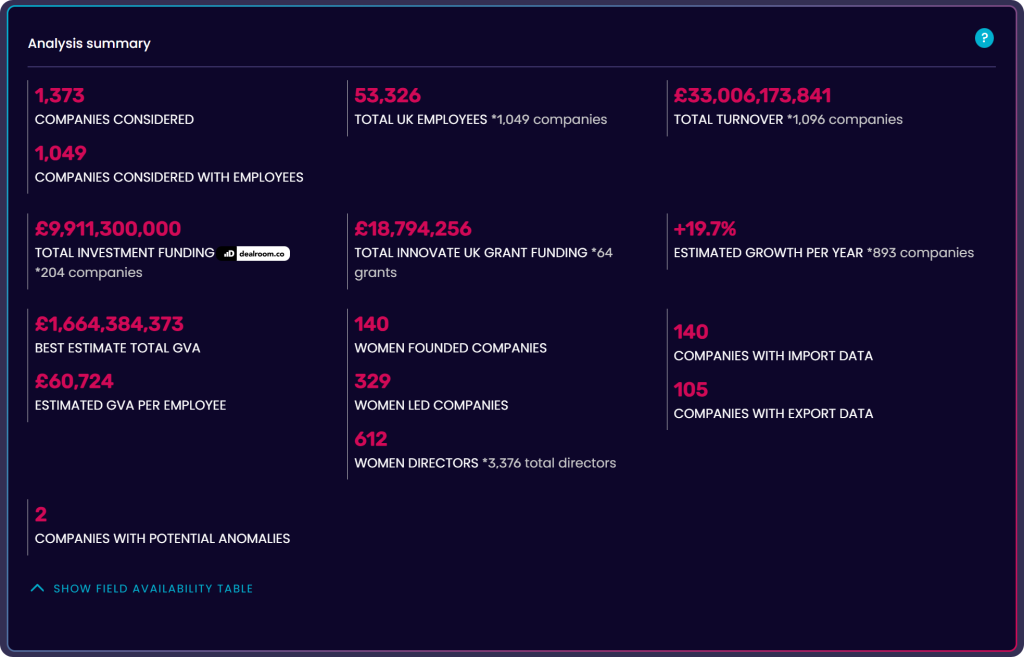
This FinRegTech sector includes 1,373 companies, supporting 53,326 UK employees and generating £33.0bn in turnover. Total identified investment stands at £9.9bn, alongside £18.8m in Innovate UK grant funding, with an estimated annual growth rate of 19.7%. The ecosystem contributes an estimated £1.66bn in GVA. There are 140 women-founded and 329 women-led companies, with 612 women directors across 3,376 directorships.
What makes up FinRegTech?
The FinRegTech RTIC is built around these core verticals:
Emerging Domains
Digital assets compliance (crypto, NFTs, MiCA), Consumer Duty compliance, and crypto AML.
General Compliance
Platforms and workflow systems for gathering, monitoring and maintaining regulatory information — including horizon scanning and tools that help firms implement new regulatory obligations.
Regulatory Reporting
Technology that collects, validates and submits required compliance or financial data to regulators.
ESG (Environmental, Social & Governance)
Solutions helping organisations manage, monitor and report on ESG‑related compliance — often using automation, analytics or Earth Observation (EO) data.
KYE (Know Your Environment)
Tools helping organisations automate and streamline compliance processes across different jurisdictions, including through agentic AI.
Tax Compliance
Solutions for real‑time transaction monitoring and auditing to identify suspicious or non‑compliant activity.
Financial Crime / AML
Technology used to detect, prevent and analyse activities linked to anti‑money laundering, counter‑terrorism financing and other financial crime.
KYC / CDD (Know Your Customer / Customer Due Diligence)
Tools and platforms that verify customer identities, assess risk profiles and support appropriate levels of scrutiny.
AI
Companies providing RegTech AI solutions, including AI assurance, across any of the sub‑sectors above.
GDPR and CCPA
Technologies helping organisations remain compliant with privacy regulations, including providers of Privacy Enhancing Technologies (PETs).
Why a modern classification system matters for government, investors and innovators
A modern classification system matters because SIC codes can’t keep up with fast‑moving, digitally driven sectors like FinRegTech. Traditional classifications simply weren’t built to recognise emerging capabilities such as AI‑powered compliance, digital identity, crypto‑asset regulation or real‑time financial crime prevention.
RTICs fix this, they use live website data and machine learning to classify companies based on what they actually do today, giving a far more accurate and up‑to‑date picture of the real FinRegTech landscape.
Government gets clearer evidence for smarter regulation, policymaking and sector support — essential in an industry where compliance technology evolves faster than official classifications.
Investors can finally see where new markets are forming and which companies are truly innovating. Helping them in spotting the next big compliance or risk‑tech companies before they scale.
Innovators become visible, not buried under outdated SIC codes that mislabel them as “software” or “business services”. With an RTIC, the companies modernising regulation are recognised for the work they actually do.
Want to explore the FinRegTech sector for yourself?
Take a look at the new FinRegTech RTIC, or sign up for a free trial to dive deeper into the data.
Please note: The Data City’s data is accurate at the time of writing but will evolve over time due to the dynamic, real‑time nature of our classification models. For the latest insights, visit our platform.