





Understanding fast-moving tech sectors like computer hardware shouldn’t be hard, but traditional classifications make it harder than it needs to be.
The way the UK defines, and measures sectors is stuck in the past, using SIC codes last updated in 2007. They weren’t built for today’s economy, and they weren’t built for sectors like chip design, embedded systems or optical processors.
That’s why we’ve updated our Computer Hardware RTIC – to provide a real-time, machine learning-powered view of the companies that make up this critical part of the UK tech ecosystem. We’ve sharpened the boundaries, updated the taxonomy, and added new verticals to give researchers, policymakers and investors a much clearer picture of the sector as it stands today.
Here’s what we’ve changed, why it matters, and who’s leading the charge.
What is Computer Hardware
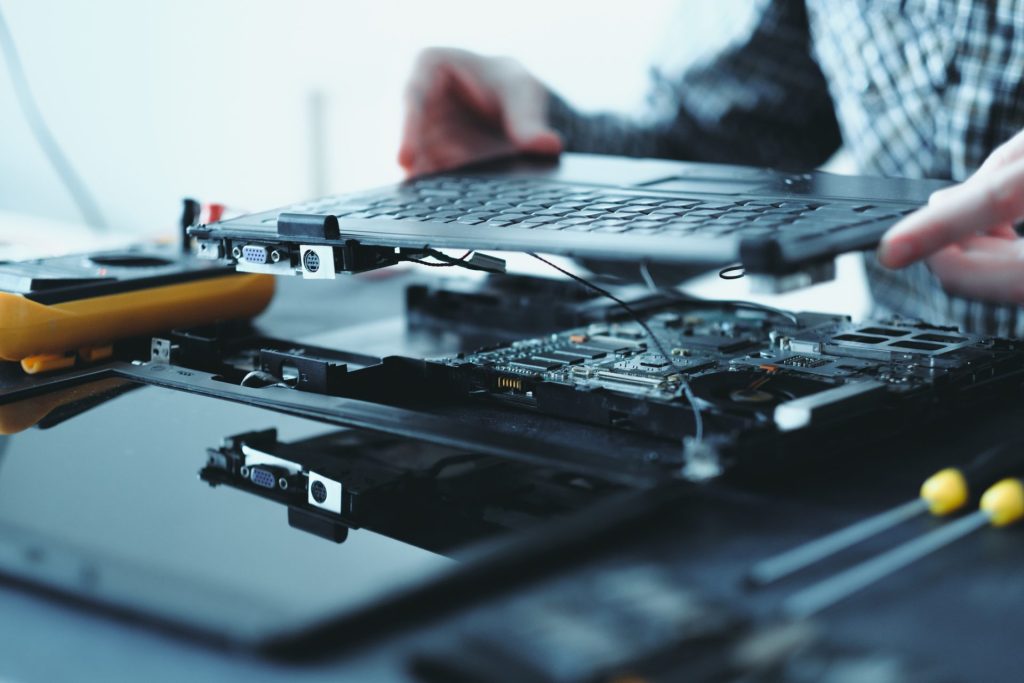
Computer hardware is the part of the UK economy that designs, builds and supports the physical components of computers and digital devices, from processors and memory to motherboards and specialist chips. It’s the backbone of the digital world, powering everything from smartphones and laptops to data centres and AI infrastructure.
Mapping the Computer Hardware sector
Mapping the computer hardware sector is crucial because it reveals key companies, their connections, and where opportunities or gaps exist. This helps businesses and policymakers make better decisions, strengthen supply chains, and support the growth of the UK’s digital economy.
However, given the technological advances in the sector, the government’s categorisation of companies’ activities using SIC codes cannot, on its own, accurately map the computer hardware sector. Since SIC codes were last updated in 2007, many new sectors of the economy are not accurately reflected in them. Additionally, there’s the challenge of companies entering incorrect codes or changing over time, which can make the data less reliable or irrelevant.
That’s why we’ve developed Real-Time Industry Classifications (RTICs) to map new sectors and to give people the data they need. RTICs use machine learning to deliver more accurate, timely insights into emerging industries, enabling a more complete understanding of dynamic markets like computer hardware.
Key changes explained
For context, our previous mapping of the sector included six subsectors: field programmable gate arrays, graphical processing units, central processing units, embedded systems, semiconductor design and manufacturing, and testing and design tools.
Building on this mapping, we introduced separate ‘assembly’ and ‘distribution’ categories, moving related companies previously scattered across other verticals into these new lists. This restructuring allows for more targeted analysis and makes it easier to focus on specific aspects of the sector.
We refined the classification system by removing companies that were too broadly defined, such as general PCB manufacturers, software-only firms, and companies making testing equipment not directly linked to computer hardware. As a result, the number of active companies dropped from 1,574 to 1,088. This created clearer boundaries for each sector and made the classifications more precise.
We refined the semiconductor category to include only companies that design and build computer chips, excluding those focused on general-purpose semiconductors or specialised materials not directly used in chip production (a separate RTIC mapping already covers the broader semiconductor industry). This update makes the UK computer hardware sector map more accurate and more closely aligned with how the industry actually operates.
Analysis of Computer Hardware RTIC
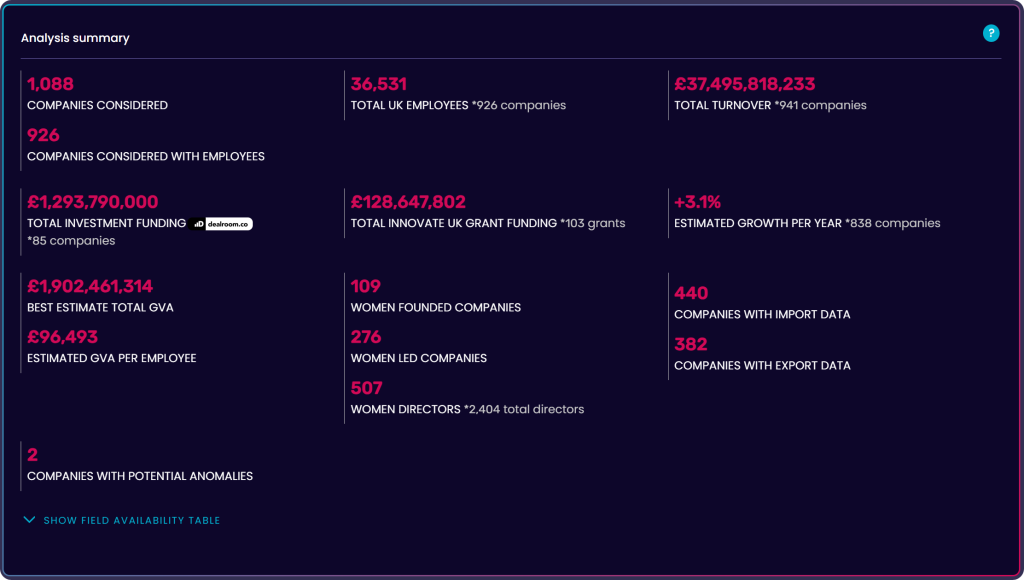
The UK Computer Hardware sector comprises approximately 1,088 companies employing 36,500 people, generating a combined turnover of £37.5 billion. The industry demonstrates stable growth with an estimated 3% annual growth rate and has attracted significant investment, including £1.2 billion in funding and £129 million in Innovate UK grants. With an estimated GVA of £1.9 billion and productivity of £96,000 per employee, the sector shows healthy economic fundamentals.
Now, some companies that stood out when mapping this sector.
Blue Shift Memory
- Estimated growth rate: +73.2% per year.
- Estimated turnover: £255,000
- Location: London
Blueshift Memory is a UK chip design company working to solve a major computer performance problem. Modern processors have become faster, but the memory that stores data has not kept up, causing computers to waste time and energy waiting to fetch data. Blueshift’s technology, called the Cambridge Architecture, redesigns how computer memory works, and they claim it makes data access up to 1,000 times faster for certain applications while using 30-50% less energy.
Their technology is useful for tasks that process large amounts of data quickly, such as artificial intelligence, computer vision, and large databases. Instead of treating every piece of data the same way, their system understands how data is organised and retrieves it more intelligently.
Lumai
- Estimated growth rate: +82.6% per year.
- Estimated turnover: £3.1m
- Location: Oxford
Lumai is developing an AI processor that uses light instead of electricity to perform calculations. Traditional AI chips are hitting limits because making them faster requires adding more silicon, which increases costs and energy consumption (Lumai.ai). Lumai’s approach uses 3D optical computing, where beams of light moving through three-dimensional space do the mathematical calculations AI systems need. This allows their processor to work much faster while using less energy than conventional chips.
The company claims its technology can deliver up to 50 times better AI performance than traditional processors while using 90% less power. This makes it particularly valuable for AI data centres, which currently face enormous electricity bills and infrastructure costs.
IntrinSic
- Estimated growth rate: +127% per year.
- Estimated turnover: £1m
- Location: London
Intrinsic Semiconductor is developing a new type of computer memory called RRAM (Resistive Random-Access Memory) that addresses a major problem in modern computing. Currently, processors are much faster than the memory they access, which slows everything down and wastes energy. Intrinsic’s solution uses silicon oxide-based RRAM that can be placed directly on processor chips, eliminating the need for separate external memory chips. This integration makes computers faster and more energy efficient. While Lumai tackles AI performance through optical computing, Intrinsic focuses on solving the memory access problem by bringing storage closer to the processor.
Their technology is particularly valuable for small computers in everyday devices like sensors and smart gadgets. The approach also keeps costs down by using common manufacturing materials.
Clarity where it counts
The Computer Hardware sector is powering everything from AI to aerospace – but you can’t support or invest in what you can’t see clearly. That’s where our updated RTIC comes in. We’ve sharpened the edges, stripped away the noise, and delivered a classification that reflects what the sector actually looks like today.
It’s not just about better data. It’s about better decisions. For policymakers designing industrial strategy. For investors spotting the next breakthrough. And for researchers making sense of a fast-moving market.
Want to find out more about our Computer Hardware RTIC and see the data in action? Sign up for a free trial today.
Please note: The data from The Data City is accurate at the time the article was written but may change over time due to the dynamic, real-time nature of our data. For the latest insights, visit our platform.