





There is some good news for fans of economic data – Standard Industrial Classification (SIC) codes, which were last updated in 2007, will finally get a refresh this year. Does this ‘SIC26’ reboot resolve one of the main challenges of using SIC codes? Well, not so fast…
What are SIC codes?
SIC codes are the sector breakdowns of the economy, providing classifications from very high levels (e.g. Manufacturing) through to very specific levels (e.g. Manufacture of men’s outerwear, other than leather clothes and workwear). They are used for economic statistics, but also for industries like banking and insurance to know what it is that their customers do.
The ONS has worked in the last couple of years, through a series of consultations and international coordination, to update these sectoral definitions. It is due to implement this SIC26 version later this month.
While the update is welcome, it isn’t the big reboot that it needs.
The forthcoming update is certainly welcome. The problem with a classification system that measures the economy as it was in 2007 means that it captures none of its subsequent evolution. That means no classifications for sectors such as FinTech, AI and Quantum.
One of the biggest changes is the better classification of net zero type activities. There are now several subsectors dedicated to solar, wind, batteries and heat pumps for example.
But the main challenge in updating SIC codes is that any changes must broadly align with international classifications (the net zero changes are an area where there was international consensus). The UK has some scope to independently tweak its own sector classification, but not very much.
This means that the update struggles to address three fundamental problems that SIC codes have.
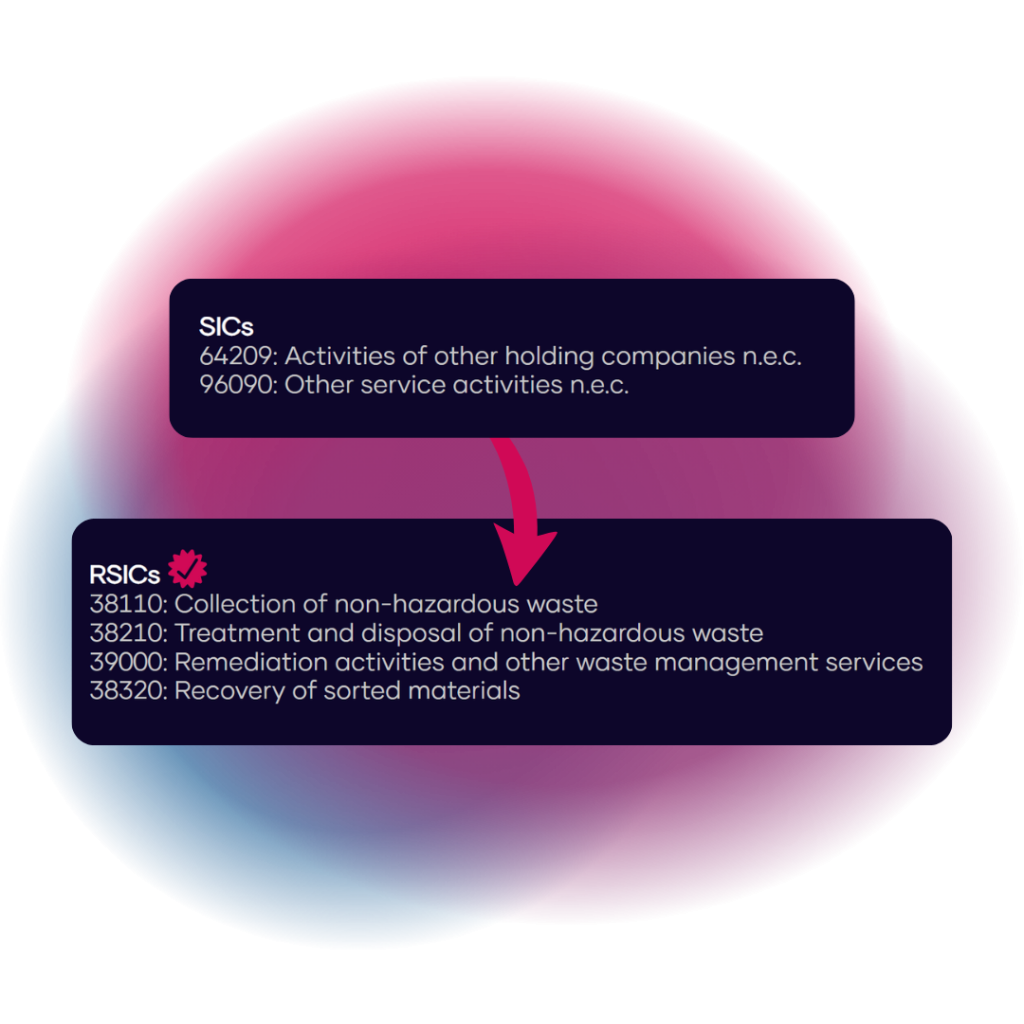
The first is that many codes aren’t particularly insightful. While ‘Activities of head offices’ isn’t wrong, it doesn’t tell you what a company actually does. ‘Professional, scientific and technical activities not elsewhere classified’ is another good example.
The second is that while the aim of the update is to better classify today’s economy, the constraints in updating it mean it is, only a partial update. Yes, it has added activities such as ‘Heat Pump Installation’ and ‘Provision of cloud infrastructure and platforms, including AI facilities and neocloud’. But much of the emerging parts of the economy remain undefined. And this means that parts of cutting-edge sectors like Life Sciences will continue to hide in areas like ‘Other professional, scientific and technical activities not elsewhere classified’.
This is inherently very hard for SIC codes to do. The emerging economy is dynamic and often emerges from the mixing of two or more traditional sectors (e.g. FinTech) which, by nature, makes it difficult for SIC to track.
The third is that even for those cutting-edge sectors that do get a specific classification, this classification isn’t especially detailed. The wordy code above is the only mention of AI, for example, in the new structure. In contrast, not only do The Data City’s Real Time Industrial Classifications have two sectors dedicated to AI, combined they are made up of 14 sub sectors to provide much greater insight on these activities.
So even the update doesn’t reflect the economy as it is today. It is already out of date. And the subsequent evolution of the economy in the coming years will exacerbate this.
SIC’s problems don’t end there
There are also two other broader issues with SIC codes than an update isn’t designed to address but have implications for the organisations that use them. It would be remiss of me not to give a recap of them.
One, they suffer from misclassification. Companies self report their SIC codes to Companies House. It’s fair to say the accuracy of this is patchy. For example, 43 companies say they grow rice. The UK doesn’t have the right climate to grow rice. And companies don’t have any incentive to go back and update them if they move into new markets.
Two, they mostly assume a company only does one thing, so that it fits neatly into one category. The world though is messy. You only have to look at recent news stories of breakthroughs in Life Sciences using AI to know that this doesn’t reflect reality.
The Data City continues to be the solution to the classification crisis
We created The Data City to deal with all these problems:
1. By looking at their websites to see what they actually do, we correct company SIC codes using our RSICs. This means no more misclassification. And it means insight as to what goes on inside those head offices.
2. We have our 66 Real Time Industrial Classifications, and the 528 sub sectors underneath them, to capture the emerging cutting-edge of the economy.
3. And we can also better classify the more foundational parts of the economy that SIC codes don’t do a good job of. If you wanted to map the events industry, say, then our machine learning tool allows you to do it.
Our data is allowing policy makers to better understand what’s going on in the economy. It is allowing investors to find companies in growth sectors. And it is allowing banks to better know their customers to comply with regulatory requirements and avoid multimillion pound fines.
Explore the economy as it actually exists today
Start a free trial and see how our Real-Time Standard Industrial Classifications (RSICs) give you a clearer, more accurate view of companies, sectors and emerging industries.