




Following equity investment into companies shows where investors are placing their bets on the economy. Using The Data City’s Real Time Indutrial Classifications (RTICs) to measure the cutting-edge of the economy combined with investment data from Dealroom, here’s a rundown of which sectors came top of the investment pops in 2025.
Finance flocked to FinTech in 2025
The cutting-edge part of the economy gets a disproportionate amount of investment. They accounted for 6% of companies but 42% of all UK company investment deals in 2025, and 76% of the amount of money invested (where these figures were declared). This likely reflects the cutting-edge nature of their activities and the potential returns investors are associating with them.
The areas of the cutting edge that performed the strongest were FinTech, Artificial Intelligence Ecosystem and Engineering Biology Supply Chain. As Figure 1 shows below, FinTech was the strongest performer. It accounted for around 3% of all cutting-edge businesses, but 13% of all investment.
Investment volumes are harder to track as not all deals declare how much was invested. But investors ploughed at least £5.2 billion into FinTech last year, with the £1.5 billion share offering from Revolut being the highest investment in the sector. This was even higher for AI Ecosystem, which secured at least £6.2 billion of investment.
| RTIC | Share of all RTIC businesses | Share of all investments in RTIC businesses | Difference (ppts) | |
| 1 | FinTech | 3% | 13% | 10.6 |
| 2 | Artificial Intelligence Ecosystem | 1% | 12% | 10.3 |
| 3 | Engineering Biology Supply Chain | 0% | 8% | 7.8 |
| 4 | Biopharmaceutical | 1% | 8% | 7.5 |
| 5 | Artificial Intelligence Technologies and Applications | 2% | 8% | 7.0 |
| 6 | Pharma | 1% | 7% | 5.8 |
| 7 | Space Economy | 1% | 6% | 4.7 |
| 8 | Life Sciences | 12% | 16% | 4.6 |
| 9 | Semiconductors | 1% | 5% | 4.3 |
| 10 | Engineering Biology Application | 0% | 4% | 3.9 |
Source: The Data City, Dealroom
Looking within FinTech, the Tech for Enterprise subsector (companies supplying software solutions to financial institutions) performed the strongest. It accounted for around one third of the broader sector’s total number of investments. Digital Payments (companies offering digital payments technologies) followed closely behind.
VC and grants played an important role in cutting-edge company investment
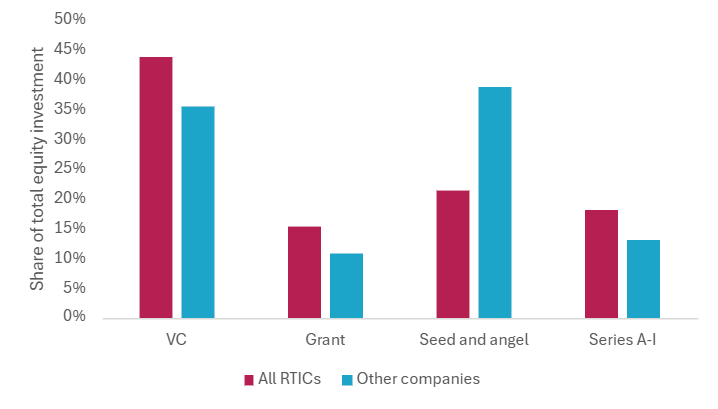
The profile of investment into RTIC companies was skewed toward venture capital and grants. Venture capital accounted for 44% of investment rounds into RTIC companies, compared to 35% for companies elsewhere in the economy. And grants made up 15% of all investment rounds in in cutting-edge companies, compared to 11% for all other companies (see Figure 2).
Source: The Data City, Dealroom
The sectors that particularly benefited from grant funding were Biopharmaceutical, Engineering Biology Supply Chain, Life Sciences and Net Zero, which combined accounted for 30% of all RTIC companies but 56% of the grant funding they received.
This points to where policymakers are placing bets, trying to support nascent companies and the broader public good that innovation in things like pharmaceuticals delivers. FinTech did not follow this pattern though, with grants making up a very small share of all its investment rounds, and venture capital playing a larger role (63% of all investment rounds).
FinTech bucked the trend of a fall in investment deals from 2024
Overall there were fewer investment deals into RTIC companies in 2025 than 2024. There was much variation within this though.
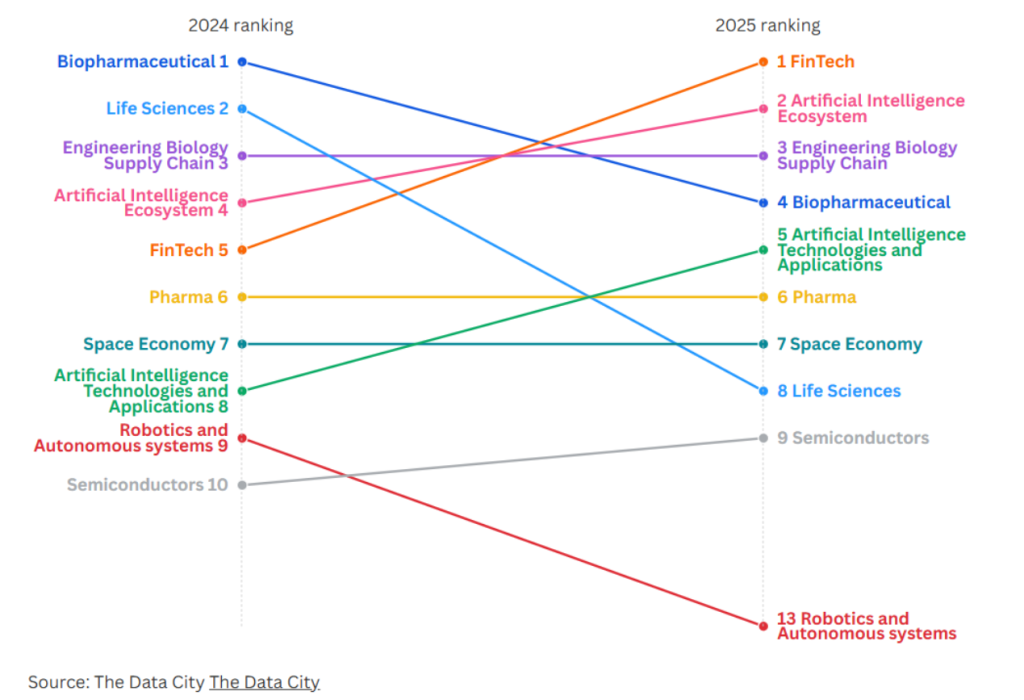
FinTech’s strong performance was well up on its 2024 performance, with the number of equity deals in the sector increasing by 16%. But 2024’s star performer Biopharmaceutical saw the number of deals fall by 36%, pushing it down to 4th in the performance table (see Figure 3).
In a year that the UK Government announced Life Sciences as one of its eight key sectors in its Industrial Strategy, Biopharmaceutical’s deal drop off was part of a broader fall in deals for Life Sciences related companies. Advanced Manufacturing, another industry singled out by the Industrial Strategy, also saw the number of equity investment deals fall, down 33% on 2024. The Government will no doubt be hoping for a turnaround in this performance in 2026
Source: The Data City; Dealroom
How to find out more
This data gives a summary of the depth of investment data that The Data City holds on the cutting edge of the economy. For more insights on investment patterns into companies, including the type of investor and size of deals, sign up for a free trial of our Industry Engine platform today.