




Demonstrating universities’ impact on industry currently relies on retrospective data and selective success stories. Most institutions justify their economic value using metrics that are 12–24 months old, such as academic output, patent filings or formal spin-out counts.
While valuable, this approach mainly tracks the “paper trail” of innovation. It misses the faster, more informal ways academia collaborates with the UK economy and it fails to measure the real value of this impact. Ultimately, it fails to capture the dynamic, real-time role universities play in shaping the knowledge networks that allow high-growth sectors to adapt and scale.
We built the Universities Industry Impact Explorer to change that. Developed in partnership with Metro Dynamics and Favier Ltd, it is a tool designed to visualise and analyse the economic ecosystem surrounding UK universities. We’re moving beyond abstract metrics to map (quite literally) the structured relationships between academia and the private sector using real-time data.
Industrial Strategy – why Universities need this data
The UK Government’s Modern Industrial Strategy, published in June 2025, identifies eight priority growth-driving sectors (the IS-8) and is explicitly channelling universities toward supporting them. From 2026, HEIF-funded activity will be expected to make the most of institutions’ distinct strengths and capabilities to deliver measurable outcomes that contribute to driving economic growth [UK Research and Innovation].
This represents a significant tightening of expectations: the first phase introduces an outcomes-focused accountability framework from 2026 to 2027, while the second will revise the funding formula to incentivise measurable contributions to economic growth from 2027 to 2028 onwards [UK Research and Innovation].
Alongside this, UKRI received £38.6 billion across the spending review period, with funding structured around outcome-oriented priorities and £6.8 billion of programmatic support specifically for Industrial Strategy sectors [UK Research and Innovation]. The Government is also rolling out apprenticeships and Growth and Skills Levy funded short courses in IS-8 sectors — with the levy funding short courses in digital, artificial intelligence, and engineering from April 2026, supporting Industrial Strategy sectors including Creative Industries and Advanced Manufacturing [Skills England, gov.uk].
Universities must now submit accountability statements demonstrating how their knowledge exchange activities align with these government priorities [UK Research and Innovation]. The message is clear: public funding for university knowledge exchange is being tied, with increasing specificity, to demonstrable contributions to the IS-8 sectors.
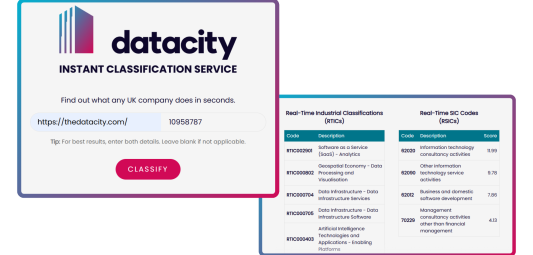
This creates an acute data problem. Universities need to understand which companies in their regions, supply chains, and partnership portfolios operate within the IS-8, but DBT’s own Sector Definitions List acknowledges that SIC codes cannot adequately define these sectors, with no suitable codes existing for key frontier industries like heat pumps, nuclear fission, complex weapons, and sustainable finance. The Data City is the only source of a workable definition of the IS-8, our Innovation Clusters Map is cited in the Industrial Strategy Technical Annex. Without real-time classification data that maps actual business activity to IS-8 sectors, universities cannot accurately report on the economic impact of their knowledge exchange, target spin-out and commercialisation support toward priority industries, or demonstrate to Research England that their HEIF allocation is generating the sector-aligned growth outcomes now required.
Understanding their relationship with IS-8 companies is no longer optional for universities. It is becoming a condition of continued public investment.
The Local Innovation Partnership Fund (LIPF)
At the time of publishing this blog, and in the context of the ‘University funding crisis’, the government has allocated significant amounts of what funding remains to initiatives directly linked to the IS-8 such as the local Innovation Partnership Fund (LIPF).
The UK’s Modern Industrial Strategy has introduced the £500m Local Innovation Partnership Fund (LIPF). Designed to support combined Industrial Strategy Zones, this fund represents a major opportunity for universities to lead place-based growth.
Securing funding demands a compelling, data-backed case that proves your institution is the anchor for a viable innovation cluster. The Universities Impact Explorer provides the evidence base needed to:
- Prove your ecosystem’s validity through granular mapping of the specific relationships that define a true innovation cluster.
- Strengthen regional partnerships by showing exactly where your research specialisms meet the needs of Strategic Authorities.
- Secure investment by replacing anecdotal success stories with a real-time, rigorous audit of your contribution to the wider economy.
Datasets
The core value of the Explorer is its ability to ground impact in real-world data. We have built a data pipeline that aggregates and links four distinct types of university-industry relationships into a single, navigable map:
- Spinouts: Identifying companies born directly from university IP.
- Research Collaborations: Mapping R&D partnerships by linking academic papers to corporate entities.
- Grant Funding: Tracking joint awards where universities and companies partner on projects based on Innovate UK data.
- Alumni Leadership: Connecting graduate records with active company directors to see where alumni’s are leading the market.
While we are currently focused on these specific datasets, we recognise that universities partner with industry in many other ways that we plan to explore in the future.
Matching
One of the hardest parts of mapping the University to Industry collaborations isn’t sourcing the data, it’s linking it.
A university might appear in a research paper under one name and in a grant application under another. So far, we’ve seen the University of Strathclyde written in 5 ways (Strathclyde University, The University of Strathclyde, The University of Strathclyde, UoS, University of Strathclyde (AFRC))!
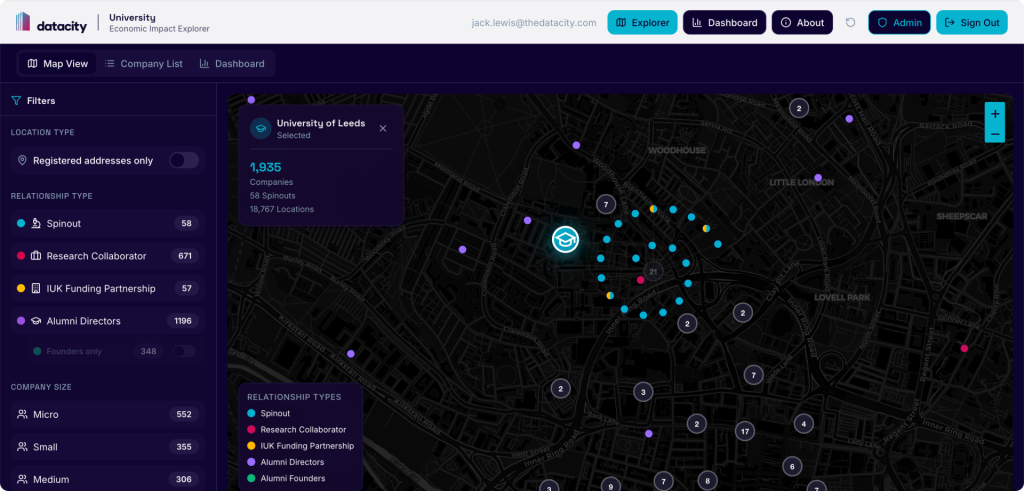
Our system moves beyond simple keyword matching. We use location data and statistical matching techniques to identify when differently written records refer to the same organisation. This allows us to accurately link universities and companies to their official Companies House records. We’ve been doing this for years with our partner datasets. The result is a view that tells us exactly which companies are interacting with which institutions, and how.
The User Interface
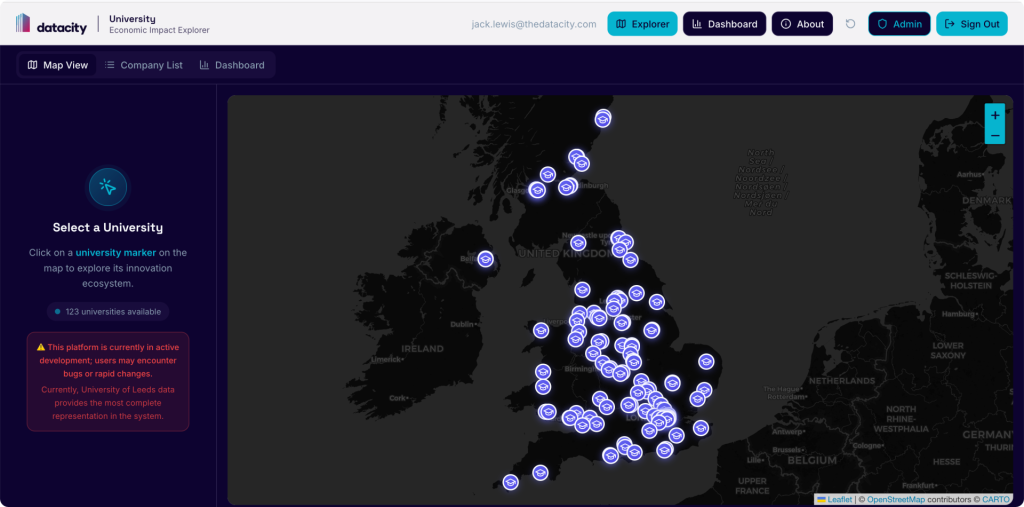
We’ve built a standalone prototype sitting outside our main product, the Industry Engine, but we wanted the user experience to be familiar. The branding is the same, we’ve pulled both some filters from the main product and our classifications. The University Impact Explorer runs heavily in the browser, allowing users to filter thousands of data points instantly.
You can select a specific University’s ecosystem, filter by Industrial Strategy classification or company size, and drill down into the specific relationship types mentioned above. We’re pulling in location information from our Industry Engine to plot these collaborations on a map and produce a dashboard summary.
Insight, Strategy, Advocacy
Why it matters now
The UK’s Modern Industrial Strategy has changed the expectation placed on universities.
It is no longer enough to demonstrate retrospective impact. Patent counts and spin-outs show what has happened. Funders now want to understand what you are intentionally building towards.
Universities are increasingly expected to articulate a clear role within regional innovation clusters and national priority sectors. They must demonstrate not just impact, but economic intent.
The Universities Impact Explorer provides the shared, real-time evidence base needed to do exactly that. It enables institutions to:
- Map their live connections to the real-time innovation economy
- Align institutional strengths with IS-8 sectors and regional growth priorities
- Demonstrate the “golden thread” between research excellence, knowledge exchange, capital investment and national missions
- Substantiate advocacy for funding with clear, data-backed evidence
Partnerships – developing your University Industrial Strategy
We’ve partnered with Metro Dynamics and Favier Ltd to wrap this tool in a new framework: Insight, Strategy, and Advocacy. The Explorer provides the evidence. The partnership turns insight into strategic intent.
We will help develop and implement a coherent institutional approach focusing on:
- Mapping institutional strengths against regional, devolved, and national economic priorities
- Designing a coherent strategy that articulates an institution’s role in innovation, cluster development, and the triple helix
- Identifying gaps in the current evidence base that limit the ability to demonstrate economic intent
- Providing targeted advocacy to support institutions in engaging with emerging funding opportunities
Outcome: A practical, targeted “University Industrial Strategy” that clearly and compellingly sets out your institutional offer and economic intent to both internal and external stakeholders. Accompanied by an internal-only set of recommendations that will provide your institution with a clear road-map for the opportunities available.
We are currently working with select partners to refine this tool in an alpha cohort. If you are interested in seeing how your institution’s impact looks on the map, get in touch with us.