





When we launched The Data City and introduced Real-Time Industrial Classifications (RTICs), we wanted to build a fairer, smarter and more efficient way to map the UK’s emerging sectors.
We noticed something broken in the system. Local governments, trade bodies, universities – anyone trying to understand what was really happening in sectors like AI, Life Sciences or EdTech – were stuck with outdated SIC codes or turning to expensive consultants for one off projects to map these sectors.
Each project came with a hefty price tag. Each report was a one-time use with the data locked away and owned by the consultant. And the next organisation who needed the same data? Back to square one.
One client. One sector. One big invoice.
And the result? Redundant and outdated research, duplicated datasets, and millions spent chasing the same answers.
We thought there had to be a better way. So we built it.
A shared foundation, not a one-time fix
Our approach is different. RTICs are collaborative. They’re built once, with a sponsor, and then published to the platform, available to every other user at no extra cost. That means:
- The sponsor gets a powerful internal and external dataset
- All other license holders gain access too – no hidden fees
- Local authorities can benchmark and compare using a shared, real-time source of truth
- Our team reinvests in growing the platform, not inflating billable hours
And crucially, the wider public sector benefits from the time and money saved.
Let’s do the maths
Sponsoring a new UK RTIC costs around £20,000.
To date, we’ve published 65 RTIC sectors (with over 500 RTIC verticals) – with over 100 public sector organisations accessing the data.
Let’s do the maths. In the old world, each of those organisations would have had to pay to map each sector. So, if all 100 organisations wanted data on the AI sector, each organisation would have had to pay a consultant a minimum of £20k, that’s = £2m (£20k x 100 orgs).
We’ve produced over 65 of these now. So that’s 65 x £2m = £130m saved.
It’s an annually updating dataset so even for just the last 5 years a potential saving of £650m.
And that’s likely a conservative estimate. Because this isn’t just about saving money, every new RTIC adds value across our entire community helping to grow the UK economy – creating shared infrastructure that works for everyone.
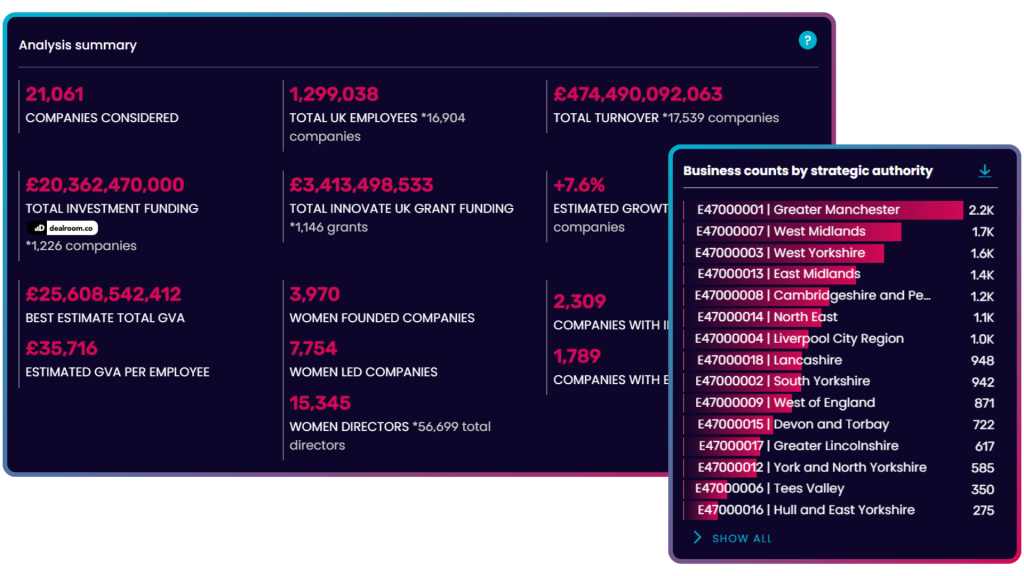
Perhaps the most famous example of this is the Department for Science, Innovation and Technology (DSIT) Innovation Clusters Map, which is the UK’s Government’s primary inward investment pitch to overseas investors wanting to find and invest in innovative UK companies.
This map features around 49 of our RTICs, some developed with DSIT themselves, whilst others were produced with a number of other partners of The Data City.
Transparent costs and value
We pride ourselves on transparency when it comes to pricing. Our standard license and project costs are listed live on our website. Take a look.
Most SaaS companies don’t publish their pricing.
Instead, they keep things vague, encourage a sales call, and tailor costs based on who you are and what you do.
Startups might get a favourable rate. Larger organisations? They’re often quoted significantly more. We think transparency is better for everyone.
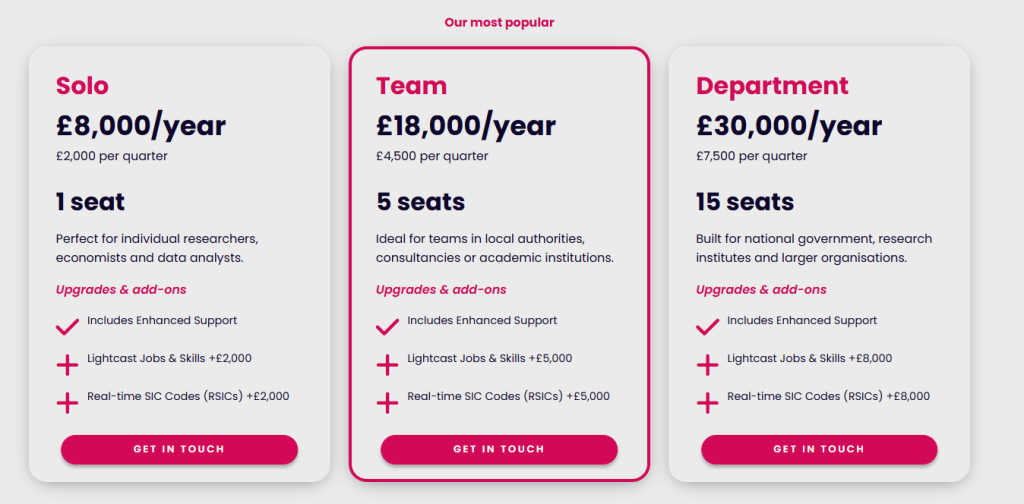
For RTIC sponsorship – where a customer helps us define and build a new sector in the platform – the cost is £20,000 to £25,000 per year.
This annual subscription funds the creation, publication and ongoing refinement of a real-time sector classification, made available to all users of The Data City platform. That means the sponsoring organisation gets a custom-built RTIC tailored to their needs, and the rest of our community, from local authorities to national government, benefits too, with no additional cost.
It’s not a one-off project. It’s a shared, national asset that stays live, accurate and useful for everyone.
Built with community, at pace
As we come to the end of 2026, we’ve been reflecting on our approach to RTICs and community building.
Our Summit in November was a highlight, bringing together clients, customers, partners and friends. It reminded us why we do what we do. Everything comes from our community.
Our product is built and developed based on user feedback, feature requests and alpha projects. Looking at our release notes, we’ve pushed a new feature, data upgrade or performance fix for almost every working day over the past 12 months. (Not including Fridays. Good developers don’t release on a Friday.)
Our focus on Industrial Strategy, the role of universities and the importance of open data exists because they matter to our users. Our business model was built around what works best for them.
If we were a consulting firm, we could charge every organisation we work with the same £20k fee to map the same sector. Again and again.
In the short term our balance sheet would look stronger. But that wouldn’t serve our customers, our community or the economy.
We believe our real-time approach to data helps overcome the limitations of outdated SIC codes. It gives a better understanding of emerging sectors in the UK, creates huge value for our users, and ultimately helps them make informed decisions that have a real effect on the world around us.
It’s all part of us delivering on our mission to build the global industrial classification system.
A huge thank you to all our customers and partners for all their support over the past five years, here’s to 2026.
As always, if you’d like hear more please do get in touch or sign up for a free trial.